UAE: +971 6 55 222 55 | USA: +1 (833) VSAT 123

In modern satellite ground station operations, broadcast teleports, and mission-critical VSAT networks, signal availability and RF chain resilience dictate commercial success. The satellite communications (SATCOM) ground segment faces relentless pressure to increase throughput, minimize rack footprint, and ensure continuous uptime against environmental, mechanical, and active-component disruptions. Among the most vulnerable active links in any down-conversion architecture are the Low-Noise Block Downconverters (LNBs) located at the antenna feed and the RF distribution paths driving downstream receivers and demodulators.
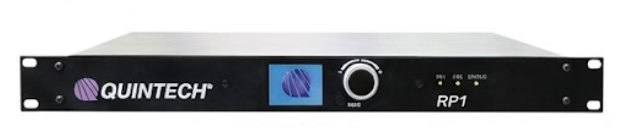
The Quintech XTREME RP1 Modular 1RU Chassis with LNB Power Insertion and Redundancy Switch Cards is an enterprise-grade hardware platform engineered specifically to solve these RF distribution, power injection, and automated failover challenges. By packing modular power control, automated switching, and frequency reference distribution into an ultra-compact 1RU profile, the RP1 eliminates cumbersome discrete bias-T blocks, bulky external power supplies, and manual A/B switches.
VSATplus, a global provider of satellite communication equipment, maritime systems, and teleport hardware, supplies the Quintech XTREME RP1 directly to satellite operators, broadcasters, and defense integrators.
The Quintech XTREME RP1 is designed around a modular backplane architecture. While traditional teleport architectures frequently rely on disparate 19-inch panels for power distribution, separate standalone coaxial bias-Ts, and external 1:1 RF sensing switches, the RP1 consolidates all of these critical subsystems into a standardized, high-density 1RU rack-mount footprint.
               +-------------------------------------------------------+
               |           QUINTECH XTREME RP1 (1RU Chassis)           |
               |                                                       |
               |  +--------------------+    +-----------------------+  |
               |  |  Hot-Swap Dual PSUs|    | Field-Replaceable Fan |  |
               |  +--------------------+    +-----------------------+  |
               |                                                       |
               |  +-------------------------------------------------+  |
               |  | 8 Hot-Swappable Card Slots (Mixed / Matched)    |  |
               |  |  - Dual LNB Bias-T Cards (Up to 16 Channels)     |  |
               |  |  - 2x1 RF Sensing Redundancy Switch Cards       |  |
               |  |  - Quick-Disconnect Switchable DC Outputs       |  |
               |  +-------------------------------------------------+  |
               |                                                       |
               |  [ 10 MHz Reference Distribution Bus Across All Slots ]|
               |  [ 2.2" Front LCD + Rotary Knob | Web GUI / SNMP / IP ]|
               +-------------------------------------------------------+
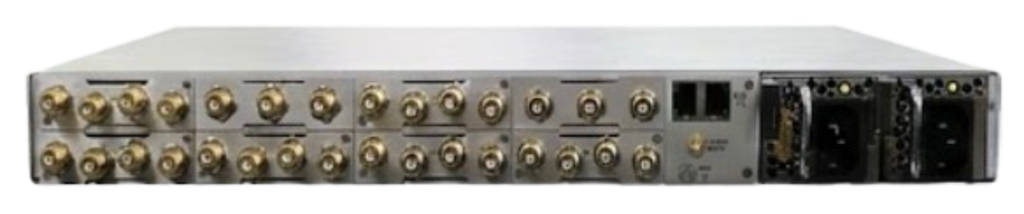
Powering active downconverters mounted directly at the antenna feed horn requires steady, filtered DC power with over-current safety mechanisms. The RP1 Dual LNB Bias-T card delivers precision power insertion directly into the coaxial RF transmission line:
For critical downlinks where feed horn or LNB loss cannot be tolerated, the RP1 accommodates up to eight 2x1 RF sensing redundancy switch cards. Powered by Quintech’s Q-SENSE technology, these cards continuously monitor the integrity of the active RF carrier path:
Modern satellite communications rely heavily on external 10 MHz reference oscillators to discipline the local oscillators (LO) of high-stability LNBs and block upconverters (BUCs). Phase noise and frequency drift directly degrade modulation error ratio (MER) and carrier-to-noise ($C/N$) ratios.
The Quintech RP1 features a dedicated 10 MHz reference input handling up to 0 dBm input power, cleanly routing and isolating the master clock across every active card slot. This eliminates the need for separate 1RU 10 MHz distribution amplifiers, freeing up valuable teleport rack space and reducing cabling complexity.

The operational and RF performance parameters of the Quintech XTREME RP1 chassis and its complementary plug-in cards are outlined below:
| Parameter | Specification Details |
| Card Architecture | Dual-channel coaxial power inserter (2 independent ports) |
| Operating Frequency Range | Standard: 950–2150 MHz / 950–2500 MHz Extended L-Band: 700–3000 MHz |
| DC Voltage Control | Selectable 0 VDC, 13 VDC, or 18 VDC per port |
| Polarity / Band Tone | 22 kHz tone insertion |
| Current Output (Continuous) | 400 mA nominal per port |
| Inrush Current Capacity | 550 mA peak inrush handling |
| High-Current 2-Pin Option | Up to 750 mA per port |
| Circuit Protection | Short-circuit protection with automatic self-reset |
| LNB Status Monitoring | Normal, Under-Current (<50 mA), and Short Circuit detection |
| Insertion Loss (Max) | 1.0 dB (950–2150 MHz) 1.0 dB (950–2500 MHz) 1.5 dB (700–3000 MHz) |
| Return Loss (Min) | 14 dB (950–2150 MHz) 12 dB (950–2500 MHz) 10 dB (700–3000 MHz) |
| Port Isolation (Min) | 65 dB minimum across operating bandwidth |
| 10 MHz Reference Input | 0 dBm maximum input power level |
| Connector Variants | F-Type (f) 75 Ω, BNC (f) 50 Ω / 75 Ω, SMA (f) 50 Ω |
| Parameter | Specification Details |
| Switch Configuration | 2 Input (Primary / Backup), 1 Output with RF Sensing |
| Operating Frequency Range | 950–2150 MHz / 950–2500 MHz / 700–3000 MHz |
| RF Sensing Dynamic Range | -50 dBm to 0 dBm |
| Maximum RF Input Power | +24 dBm |
| Insertion Loss | 3.0 ± 0.5 dB (950–2150 MHz) 3.0 ± 1.0 dB (950–2500 MHz) 3.5 ± 1.0 dB (700–3000 MHz) |
| Return Loss (Min) | 14 dB (950–2150 MHz) 13 dB (950–2500 MHz) 10 dB (700–3000 MHz) |
| Channel Isolation (Min) | 50 dB (950–2150 MHz) 50 dB (950–2500 MHz) 45 dB (700–3000 MHz) |
| Connector Variants | F-Type (f) 75 Ω, BNC (f) 50 Ω / 75 Ω, SMA (f) 50 Ω |
| Parameter | Specification Details |
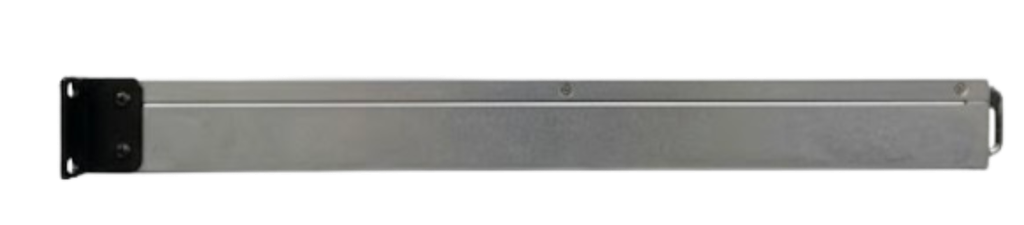
| Form Factor | Standard 19-inch rack mount, 1RU height |
| Physical Dimensions | 1.75” H x 19.0” W x 18.5” D (44.45 mm x 482.6 mm x 469.9 mm) |
| Weight | Net: 9.0 lbs (4.08 kg) Gross / Shipping: 12.0 lbs (5.44 kg) |
| Card Slot Capacity | 8 hot-swappable I/O card bays |
| Max Port Capacity | Up to 16 Bias-T power inserters or eight 2x1 switch cards |
| Power Supply Type | Dual redundant, hot-swappable AC power supply units |
| Input Voltage Range | 100–240 VAC auto-ranging, 50/60 Hz |
| Power Consumption | 10 Watts standby; 200 Watts maximum fully loaded |
| Thermal Management | Field-replaceable, high-reliability cooling fan module |
| Local Front-Panel UI | 2.2-inch graphic LCD screen with interactive rotary control knob |
| Network Management | Single/Dual 10/100/1000 Base-Tx Ethernet (RJ-45) |
| Remote Protocols Supported | Embedded Web Browser GUI (HTTP/HTTPS), SNMP (v2c/v3), Quintech TCP/IP API |
Deploying the Quintech XTREME RP1 inside satellite ground stations yields distinct operational, RF, and lifecycle advantages:
Traditional satcom systems operate between 950 and 2150 MHz. However, next-generation High Throughput Satellites (HTS), Low Earth Orbit (LEO) constellations, and ultra-wide transponders utilize extended L-band (up to 2500 MHz or 3000 MHz) to ingest wider frequency allocations without splitting channels. The RP1’s full 700–3000 MHz transparent passband ensures long-term operational relevance, preventing costly hardware replacements as teleports upgrade to wider carrier bandwidths.
In satellite uplink/downlink facilities, rack space is at a premium. A fully populated RP1 chassis delivers up to 16 channels of regulated LNB power insertion or eight independent 2x1 redundancy switch paths in a single rack unit (1RU). Achieving this level of density with modular standalone devices would typically require 3RU to 5RU of rack space, extensive patch cabling, and multiple wall-plug power adapters.
Unattended teleports, remote flyaway terminals, and offshore platforms require continuous monitoring. The RP1 features an embedded web server and robust SNMP (Simple Network Management Protocol) support. Teleport engineers can remotely verify individual LNB current draw, manually toggle 13/18V rail states, initiate RF carrier switchovers, and monitor chassis temperature from centralized Network Operations Centers (NOCs).
All primary failure-prone components—power supplies, cooling fans, and active RF cards—are hot-swappable and field-replaceable. A technician can swap an active I/O card, replace a power supply, or install a new fan tray while the chassis remains live in the equipment rack without disturbing adjacent RF channels.
+---------------------------------------------------------------------------------------+
|                                 OPERATIONAL BENEFITS                                  |
+---------------------------+-------------------------------+---------------------------+
|      High Reliability     |      Rack Consolidation       |    Future-Proof Bandwidth |
|  Dual Redundant Hot-Swap  |   16 Bias-T Ports or 8 2x1    |  700 - 3000 MHz Extended  |
|  Power & Fan Assemblies   |  Redundancy Switches in 1RU   |    L-Band Capabilities    |
+---------------------------+-------------------------------+---------------------------+
|    Real-Time Telemetry    |      Built-in 10 MHz Bus      |    Automated Failover     |
| Current (<50mA), Voltage, | Direct Backplane Distribution |  Q-SENSE Autonomous RF    |
| & Short Detection Alerts  |   to Cleanly Drive All LNBs   |   Switching in <1 Second  |
+---------------------------+-------------------------------+---------------------------+
Large multi-dish earth stations receiving hundreds of linear television channels, corporate IP streams, or data feeds require pristine L-band power injection. The RP1 ensures that downconverters on C, Ku, and Ka-band antennas receive uninterrupted, low-noise DC voltage. The built-in under-current detection provides early warning if an LNB begins to degrade, allowing preventative servicing before transponder links drop.
In prime-focus and Gregorian multi-feed antennas, downlinks are frequently split across active and standby LNB pairs. By populating the RP1 chassis with 2x1 RF Sensing Redundancy Switch Cards, operators achieve automated, hardware-level fault mitigation. If an active LNB is damaged by an electrical surge or water ingress, the RP1 automatically detects RF power loss and switches to the standby LNB within milliseconds, preserving service-level agreements (SLAs).
Deployable SATCOM trailers, flyaway terminals, and tactical military networks operate under harsh conditions where commercial wall-warts and unmonitored power taps are unacceptable. The RP1’s rugged 1RU steel chassis, high return loss, wide input AC supply range (100–240 VAC), and MIL-friendly SMA or BNC connector options make it well-suited for expeditionary communication systems.
Vessels, drillships, and offshore energy platforms subject satellite tracking systems to severe vibration, salt mist, and mechanical wear. The RP1 provides clean, monitored DC power to marine stabilized antennas while offering remote engineering teams via SNMP the ability to diagnose LNB current faults without climbing the mast.
When procuring mission-critical RF infrastructure, working with an experienced distributor ensures proper hardware configuration, matching connector impedances, and reliable supply chain execution. VSATplus is an established distributor and solutions provider for top-tier satellite equipment, supplying the complete Quintech RF reliability product line.
To purchase the Quintech XTREME RP1 Modular 1RU Chassis or request a competitive quote, contact the sales and engineering division at VSATplus:
The Quintech XTREME RP1 represents a benchmark in RF power injection and signal routing reliability. By consolidating 16 channels of Bias-T power, automated Q-SENSE RF sensing failover, 10 MHz reference distribution, and full SNMP/Web GUI telemetry into a single 1RU chassis, it addresses the core operational challenges facing modern satellite teleports.
Whether building a new greenfield ground hub, retrofitting an aging teleport, or expanding into extended L-band HTS services, the RP1 provides the flexibility, density, and continuous-uptime assurance that operators require. Contact VSATplus today to configure and order your Quintech RP1 modular system.