UAE: +971 6 55 222 55 | USA: +1 (833) VSAT 123

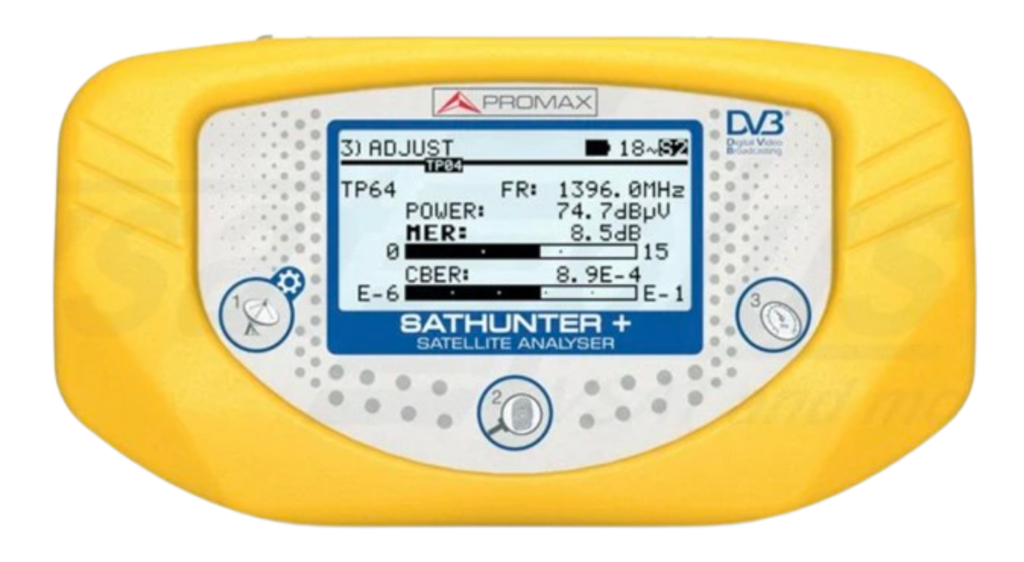
Installing and aligning a satellite antenna correctly is one of the most important steps in building a reliable satellite communication or Direct-to-Home (DTH) reception system. Even a high-quality antenna, LNB and receiver can deliver poor performance if the dish is not accurately pointed toward the intended satellite. Professional installers therefore need a reliable field instrument that can detect satellite signals, identify the correct satellite, measure signal quality and help optimize antenna alignment.
The PROMAX SATHUNTER+ DVB-S/S2 Satellite Hunter is designed specifically for this purpose. It is a portable satellite installation and measurement instrument developed for the installation of DVB-S and DVB-S2 satellite reception systems. According to the supplied product documentation, the SATHUNTER+ combines three important functions in a single field instrument: satellite signal detection, satellite identification and precise signal adjustment.
Unlike a basic satellite finder that simply indicates signal strength, the SATHUNTER+ can actually read information transmitted by the satellite and display the satellite orbital position, network information and service list. This provides installers with much greater confidence that they have located the intended satellite rather than simply detecting an unrelated signal.
For professional satellite installers, network operators, DTH technicians and system integrators, the SATHUNTER+ provides a practical combination of portability, measurement capability, satellite identification and outdoor durability.
VSATPlus provides satellite communication and RF equipment solutions and can supply the PROMAX SATHUNTER+ for customers requiring a professional satellite installation and alignment instrument. Contact VSATPlus for product availability, pricing and ordering.
The SATHUNTER+ is a DVB-S/DVB-S2 satellite hunter and measurement instrument designed primarily for field installation and optimization of satellite reception systems.
Its operation is based on a simple three-stage process:
During detection, the instrument searches for satellite RF signals. Its built-in wideband detector allows it to detect signals from both analogue and digital satellites. In this mode, it operates similarly to a conventional satfinder, displaying received signal power through graphic bars and providing an audible indication.
Once a satellite signal has been found, the SATHUNTER+ moves beyond simple signal-strength measurement. Its identification function reads information from the satellite’s transport stream tables at preprogrammed test frequencies. This enables the installer to confirm the actual satellite being received.
Finally, the adjustment stage provides digital measurements such as channel power, MER and CBER, allowing the installer to optimize the antenna position and achieve the best possible reception performance.
This three-step approach is one of the most useful characteristics of the SATHUNTER+ because it combines basic signal discovery with actual digital signal analysis.
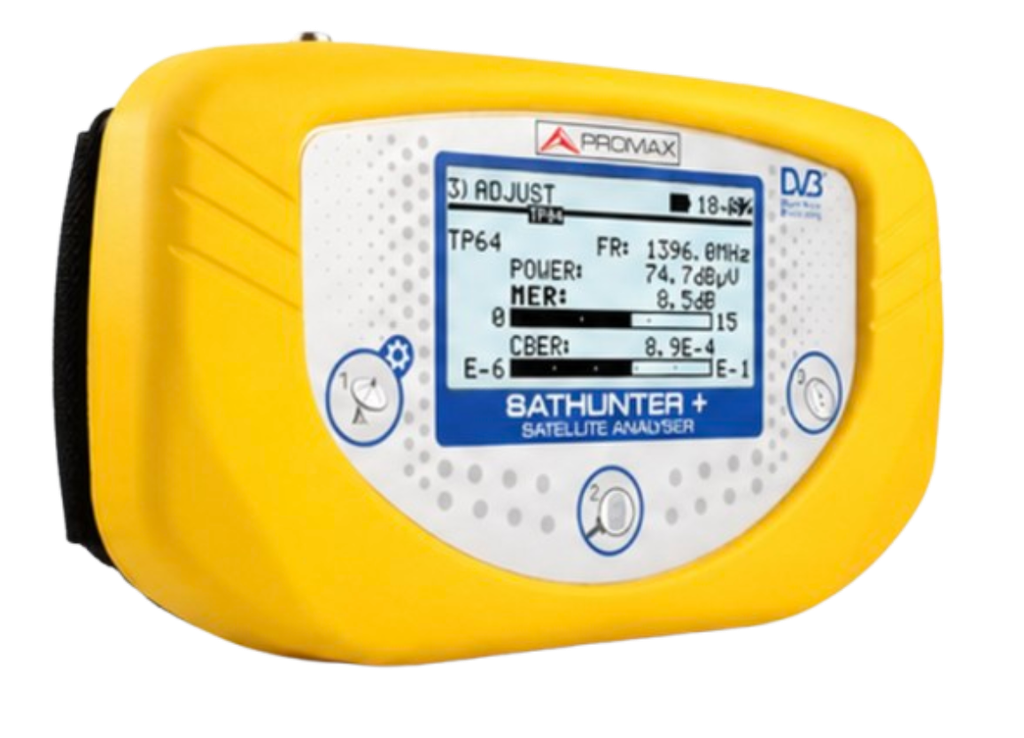
The first challenge when installing a satellite dish is finding a usable satellite signal.
The SATHUNTER+ includes a wideband detector capable of detecting signals from analogue or digital satellites. The instrument provides visual signal-level information through two graphic bars with different time constants and also provides an audible signal indicator.
This makes the initial antenna-pointing process easier because the installer does not need to continuously look at the instrument display while physically adjusting the dish.
The detection function is particularly useful when performing rough azimuth and elevation adjustments.
Finding a signal does not necessarily mean finding the correct satellite.
This is a major difference between a professional satellite identification instrument and a simple signal meter.
The SATHUNTER+ reads information transmitted by the satellite through transport-stream tables. It can then display information such as:
The instrument can be programmed with up to 50 satellites, allowing installers to configure the meter according to their specific requirements.
This selective identification capability can be particularly useful for companies working with a specific DTH platform or satellite network. Instead of allowing an installer to stop at the first detected signal, the equipment can be configured to recognize the required satellite.
That can reduce installation errors and unnecessary return visits.
After the correct satellite has been identified, the installer needs to optimize the antenna alignment.
The SATHUNTER+ provides several digital measurements designed for this stage, including:
MER and CBER are particularly useful during dish alignment because they provide quantitative information about signal quality rather than simply showing signal strength. The product documentation states that these measurements can be displayed numerically as well as graphically.
This allows the installer to make small adjustments to azimuth, elevation and polarization while monitoring the effect on actual reception quality.
The SATHUNTER+ supports both DVB-S and DVB-S2, making it suitable for a broad range of satellite reception installations.
For DVB-S, the instrument supports symbol rates from 2 to 45 Mbaud and code rates from 1/2 through 7/8. Spectral inversion can also be selected as ON or OFF.
SATHUNTERp.pdf
For DVB-S2, the instrument supports both QPSK and 8PSK modulation with symbol rates from 2 to 45 Mbaud. It also supports multiple DVB-S2 code rates and roll-off factors of 0.20, 0.25 and 0.35.
This DVB-S2 capability is important because modern satellite networks increasingly use DVB-S2 transmission technology to achieve greater spectral efficiency.
The SATHUNTER+ covers an RF tuning range of:
950 MHz to 2150 MHz
This is the standard L-band frequency range used between many satellite LNBs and satellite receivers/modems.
The instrument therefore connects to the satellite reception chain through the LNB’s IF output and analyzes the converted satellite signal.
Its RF input has an impedance of 75 Ω, while the supplied documentation specifies a universal input arrangement with interchangeable BNC, DIN and F adapters.
The level measurement range is:
30 dBµV to 110 dBµV
with a maximum signal level of:
120 dBµV.

One of the strongest advantages of the SATHUNTER+ is that it is not limited to signal detection.
The instrument provides several important digital satellite measurements.
| Measurement | Specification |
|---|---|
| Power measurement | 40–100 dBµV |
| MER | 0–25 dB |
| CBER | 1E-6 to 1E-1 |
| VBER | 1E-8 to 1E-3 |
| LBER | 1E-8 to 1E-3 |
| DVB-S | Supported |
| DVB-S2 | Supported |
| QPSK | 2–45 Mbaud |
| 8PSK | 2–45 Mbaud |
| RF tuning range | 950–2150 MHz |
| RF impedance | 75 Ω |
| Maximum measurement points | 50 |
The VBER measurement is specified for DVB-S, while LBER is specified for DVB-S2.
These measurements allow technicians to evaluate not only whether a satellite signal exists, but also whether the signal quality is sufficient for reliable reception.
Satellite identification is arguably one of the most practical features for field technicians.
The SATHUNTER+ can display the detected satellite’s azimuth and orbital position, when available. It can also display the service name, up to the first 32 services, and network or bouquet information when detected.
The instrument can be configured with up to 50 measurement points/satellites. Configuration is performed through a serial connection to a PC using the supplied cable and software.
This provides an important level of customization.
For example, a satellite installation company working primarily with a particular DTH operator can configure the meter with the relevant satellites and test frequencies. The installer then has a field instrument optimized for the company’s normal deployment workflow.
The supplied documentation specifically highlights selective identification as a feature.
The SATHUNTER+ can be programmed for a specific application, such as aligning a dish to a specific satellite. This can be particularly useful for installers working for a particular DTH platform who want to minimize the possibility of selecting the wrong satellite.
Settings can be modified using a PC and the supplied software.
This capability provides several operational benefits:
For organizations managing multiple field technicians, this can be a valuable feature.
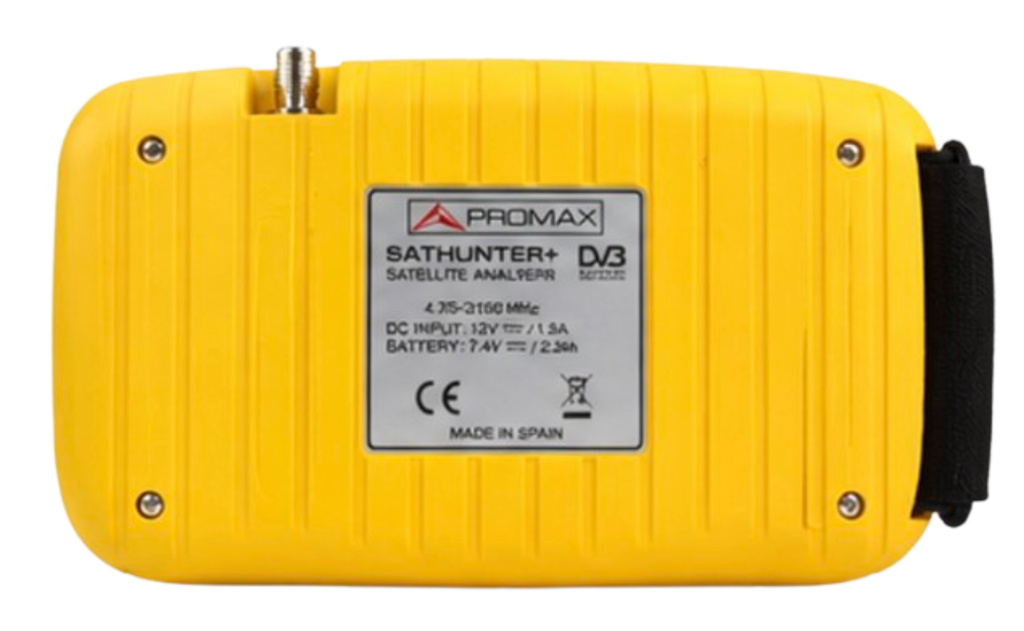
A satellite field meter must be capable of powering the LNB because the LNB normally requires DC power.
The SATHUNTER+ supplies external units through its RF input connector.
The specified output voltages are:
The maximum output current is:
300 mA.
SATHUNTERp.pdf
The instrument also supports a selectable 22 kHz signal with:
This makes the instrument suitable for working with Universal LNB configurations where 13/18 V and 22 kHz control are used.
Outdoor satellite installations can sometimes involve damaged coaxial cables, incorrectly connected connectors or faulty LNBs.
The SATHUNTER+ includes protection and diagnostic functions for these situations.
According to the supplied documentation, the equipment can detect excessive LNB consumption and indicate cable outages or faulty LNB operation. It also includes a short-circuit detection feature.
This is useful because technicians can identify certain problems at the installation point rather than having to troubleshoot the entire satellite receiver system separately.
Satellite installation equipment needs to survive field use.
The SATHUNTER+ is designed as a portable outdoor instrument with a water-resistant front panel and a sturdy ABS case.
The RF input connector is described as a comfortable replaceable connector, and the instrument is supplied with a hard transport case.
Its mechanical design is therefore aimed at technicians who regularly travel between installation sites.
Battery performance is particularly important for satellite meters because the instrument may need to continuously power the LNB while the technician is working.
The SATHUNTER+ uses a:
7.4 V, 2.2 Ah Li-Ion battery
The specified typical autonomy is 80 minutes while powering a Universal LNB and continuously identifying a signal.
Charging time is approximately:
100 minutes
The charger includes an automatic charging-control function that disconnects the powering process when charging is complete.
A car cigarette-lighter adapter is also supplied, allowing the instrument to be charged while traveling between installation locations.
Portability is another important advantage.
The SATHUNTER+ measures:
180 × 95 × 50 mm
and weighs approximately:
480 g.
At less than half a kilogram, it is designed to be carried and operated by technicians during outdoor antenna installation.
The compact form factor is particularly convenient when installers need to climb rooftops, towers or other antenna locations while carrying additional tools and equipment.
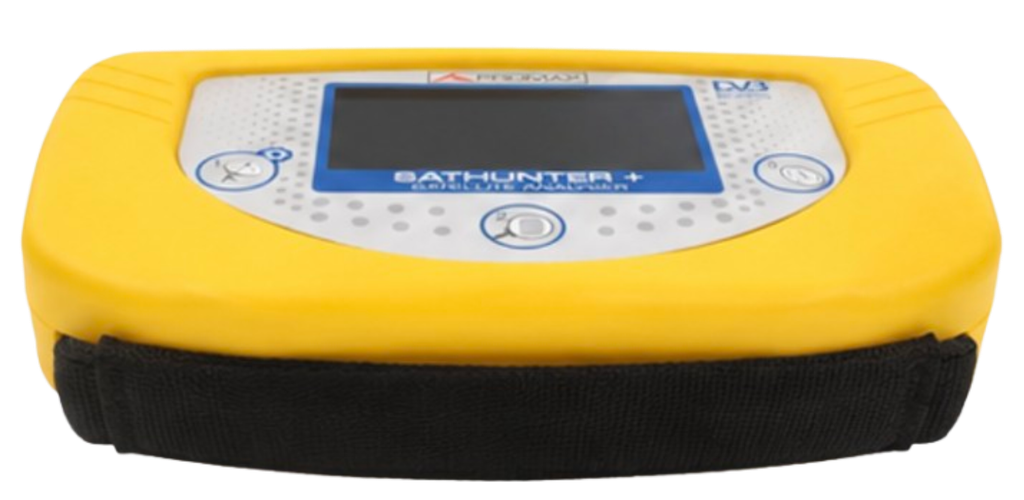
The following table summarizes the principal specifications provided in the supplied PROMAX SATHUNTER+ documentation.
| Category | Specification |
|---|---|
| Product | PROMAX SATHUNTER+ |
| Application | DVB-S/S2 Satellite Hunter |
| Frequency Range | 950–2150 MHz |
| RF Input Impedance | 75 Ω |
| RF Connector | Universal, BNC/DIN/F interchangeable adapter |
| Level Range | 30–110 dBµV |
| Maximum Signal Level | 120 dBµV |
| DVB-S Symbol Rate | 2–45 Mbaud |
| DVB-S2 QPSK Symbol Rate | 2–45 Mbaud |
| DVB-S2 8PSK Symbol Rate | 2–45 Mbaud |
| DVB-S Roll-Off | 0.35 |
| DVB-S2 Roll-Off | 0.20, 0.25, 0.35 |
| MER Measurement | 0–25 dB |
| CBER | 1E-6 to 1E-1 |
| VBER | 1E-8 to 1E-3 |
| LBER | 1E-8 to 1E-3 |
| Measurement Points | Up to 50 |
| LNB Voltage | 13 V / 18 V ±1 V |
| Maximum LNB Current | 300 mA |
| 22 kHz Voltage | 0.6 V ±0.2 V |
| 22 kHz Frequency | 22 kHz ±4 kHz |
| Battery | 7.4 V, 2.2 Ah Li-Ion |
| Typical Autonomy | 80 minutes |
| Charging Time | Approx. 100 minutes |
| Mains Adapter | 90–250 V, 50/60 Hz |
| DC Adapter | 12 V DC, 20 W |
| Dimensions | 180 × 95 × 50 mm |
| Weight | 480 g |
| Display | Automatic backlight |
| PC Configuration | USB/serial configuration with supplied software |
| Accessories | Power adapter, car adapter, RF adapters, USB cable, battery, carrying case and belt |
The specifications in this table are based on the supplied SATHUNTER+ product documentation.
The SATHUNTER+ is particularly well suited to Direct-to-Home satellite reception installations.
Technicians can use it to detect the satellite, confirm satellite identity and optimize the antenna.
For satellite installers, the combination of signal power, MER and error-rate measurements provides a more complete picture of antenna performance than a simple signal-strength meter.
Its support for both DVB-S and DVB-S2 makes it suitable for installations using different generations of satellite transmission technology.
The instrument can also be useful during troubleshooting and maintenance. Technicians can measure signal parameters directly at the antenna rather than relying entirely on the indoor receiver or modem.
The programmable satellite identification feature can be particularly useful for companies operating multiple installation teams. A standardized configuration can help technicians follow a consistent installation procedure.

The instrument does more than detect RF energy. It can read satellite information and display orbital position and service information.
Its support for both DVB-S and DVB-S2 allows it to work with a broad range of satellite reception systems.
MER, CBER, VBER and LBER measurements allow technicians to evaluate signal quality and optimize antenna alignment.
Up to 50 satellites or measurement points can be configured, making the meter adaptable to different installation environments.
13/18 V LNB powering and 22 kHz control allow the instrument to operate directly with compatible satellite LNB configurations.
The protection system helps identify excessive LNB consumption and short-circuit conditions.
Its ABS housing, water-resistant front panel, compact dimensions and 480 g weight make it appropriate for outdoor installation work.
The integrated 7.4 V/2.2 Ah battery provides approximately 80 minutes of typical operation while continuously powering a Universal LNB and identifying a signal.
A satellite installation requires more than simply finding the strongest available signal.
A dish can accidentally receive a neighboring satellite, particularly in locations where several satellites are positioned relatively close together. A simple signal-strength meter may indicate a strong signal while providing no certainty about which satellite has actually been found.
The SATHUNTER+ addresses this issue through its identification capability.
Its workflow allows the technician to first locate the signal, then verify the satellite and finally optimize the antenna using digital quality measurements. This provides a more structured installation process and can reduce the risk of incorrect alignment.
The ability to program specific satellites and test frequencies is also valuable for professional installation companies that need repeatable field procedures.
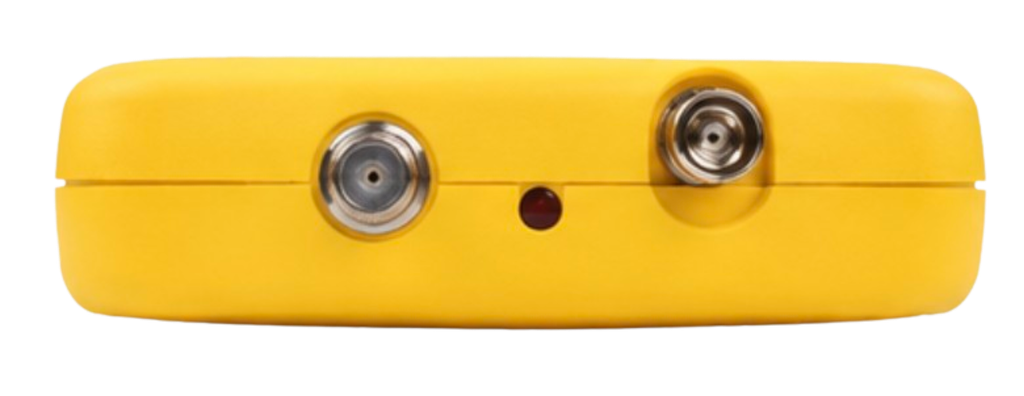
For satellite installers, system integrators, DTH service providers and organizations involved in satellite antenna deployment, the PROMAX SATHUNTER+ provides a compact solution for satellite detection, identification and signal-quality optimization.
VSATPlus offers satellite communication and RF equipment solutions and can provide the SATHUNTER+ for professional satellite installation applications.
When requesting the SATHUNTER+, customers can contact VSATPlus for:
VSATPlus can help customers identify the appropriate satellite measurement solution based on their deployment requirements.
The PROMAX SATHUNTER+ DVB-S/S2 Satellite Hunter is a professional portable instrument designed to simplify the installation and optimization of satellite reception systems.
Its greatest advantage is the combination of detection, identification and adjustment in one compact field instrument. Instead of relying solely on signal strength, installers can detect a satellite signal, identify the satellite through transmitted information and then optimize the antenna using measurements such as MER, CBER, VBER and LBER.
The instrument supports 950–2150 MHz, DVB-S and DVB-S2 signals, symbol rates up to 45 Mbaud, 13/18 V LNB powering, 22 kHz control, programmable satellite profiles and up to 50 measurement points.
Its rugged ABS construction, water-resistant front panel, compact 180 × 95 × 50 mm design and 480 g weight make it practical for field technicians. The integrated Li-Ion battery, car charging adapter and carrying accessories further support mobile installation work.
For professional satellite installation teams, DTH technicians and satellite system integrators, the SATHUNTER+ offers a useful combination of portability, satellite identification, digital measurement capability and field-oriented design.
The PROMAX SATHUNTER+ is available through VSATPlus. Contact VSATPlus today for pricing, availability and ordering information for your satellite installation requirements.