UAE: +971 6 55 222 55 | USA: +1 (833) VSAT 123


In modern broadcast teleports, satellite earth stations, and high-density Cable Television (CATV) headends, signal distribution remains one of the most critical engineering hurdles. As distribution networks scale to accommodate dozens or hundreds of downstream endpoints—such as receiver racks, monitoring gear, demodulators, and test consoles—the physical degradation of passive RF signal chains becomes an unavoidable bottleneck.
Traditional passive splitting splits not only the path but also divides the RF energy, introducing severe insertion loss that must be compensated for with external gain blocks, equalizers, and jumper cables. This traditional approach introduces impedance mismatches, phase distortion, and cable chaos.
The Quintech LS 1000A Series—comprising the LS16 1000A, LS32 1000A, LS48 1000A, and LS64 1000A—delivers a commercial-quality, amplified "zero-loss" solution designed to resolve these distribution dilemmas. Operating across the 5 to 1000 MHz spectrum, this series combines internal microstrip RF amplification with high-density rack-mount packaging to streamline downstream distribution.
As an established global distributor of commercial satellite equipment, teleport hardware, and maritime RF systems, VSATplus supplies and supports the Quintech LS 1000A Series worldwide.
Passive RF splitters are constrained by fundamental physics: every time an RF signal is split in two ($1\times2$), the ideal theoretical power drop is approximately $3\text{ dB}$ (plus residual dielectric/resistive insertion losses). By the time an operator splits a broadband feed 16, 32, 48, or 64 ways using cascaded passive splitters, signal attenuation drops precipitously:
To recover this lost signal budget, engineers traditionally cascade multiple standalone pre-amplifiers, inline distribution amplifiers, and passive splitters. This cascading introduces several severe failure modes:
The Quintech LS 1000A Series solves this fundamental problem by integrating active, amplified microstrip-splitting circuitry into a single, shielded chassis. Quintech achieves an insertion loss of $0 \pm 2\text{ dB}$ at 500 MHz across all models.
This unity-gain (amplified zero-loss) architecture reproduces the signal level at the single RF input evenly across all 16, 32, 48, or 64 output ports without requiring additional post-amplification.
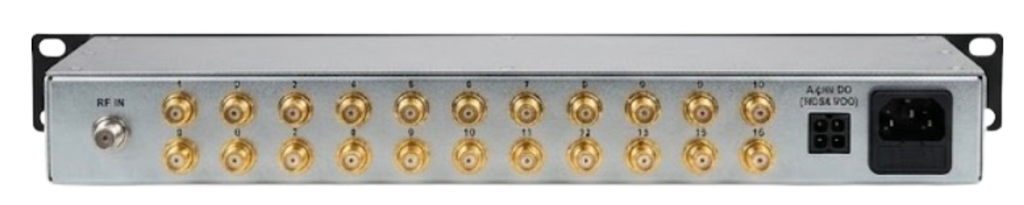
The LS 1000A Series is engineered around several core proprietary technologies that separate commercial-grade infrastructure from consumer or semi-professional distribution gear:
Covering the entire sub-split, low-band, VHF, UHF, and CATV return/forward spectrum from 5 MHz up to 1 GHz, the LS 1000A is built to service legacy downstream cable feeds, digital terrestrial television (DVB-T2/ATSC), high-frequency intermediate (IF) carrier bands, and sub-gigahertz telemetry distribution.
Quintech utilizes proprietary printed microstrip transmission line technology rather than hand-wound ferrite core transformers. Microstrip etching guarantees trace-to-trace impedance uniformity, strict phase matching, high port-to-port isolation, and long-term mechanical reliability immune to vibration and shock.
A single LS64 1000A chassis replaces up to nine discrete passive splitters ($1\times8$ driving eight $1\times8$s) and associated distribution amplifiers. Eliminating cascaded stages dramatically tightens the system’s group delay, minimizes intermodulation distortion, and preserves dynamic range.
The chassis line uses a standard 19-inch rack-mount profile, scaling cleanly based on port count:
Centralizing connections on the rear plane keeps cable routing uniform, simplifies labeling, and drastically cuts down on connector failures caused by technicians repeatedly mating and demating patch cables during routine troubleshooting.
Every model in the LS 1000A family supports flexible power arrangements, accommodating both facility 100–240 VAC, 50/60 Hz mains power and isolated 18–24 VDC operations via a heavy-duty 2-pin quick-connect barrier strip. This dual-capability accommodates teleport installations with dedicated DC battery backup systems alongside conventional AC-fed data center racks.
The table below outlines the full factory technical parameters for the Quintech LS 1000A line, spanning the 16-, 32-, 48-, and 64-way configurations:
| Parameter | LS16 1000A | LS32 1000A | LS48 1000A | LS64 1000A |
| RF Configuration | $1 \times 16$ (1 Input, 16 Outputs) | $1 \times 32$ (1 Input, 32 Outputs) | $1 \times 48$ (1 Input, 48 Outputs) | $1 \times 64$ (1 Input, 64 Outputs) |
| Operating Frequency | 5 – 1000 MHz | 5 – 1000 MHz | 5 – 1000 MHz | 5 – 1000 MHz |
| RF Connector Options | F-Type, BNC ($75\ \Omega$) | F-Type, BNC ($75\ \Omega$) | F-Type, BNC ($75\ \Omega$) | F-Type, BNC ($75\ \Omega$) |
| Impedance | $75\ \Omega$ nominal | $75\ \Omega$ nominal | $75\ \Omega$ nominal | $75\ \Omega$ nominal |
| Insertion Loss | $0 \pm 2\text{ dB} \text{ @ } 500\text{ MHz}$ | $0 \pm 2\text{ dB} \text{ @ } 500\text{ MHz}$ | $0 \pm 2\text{ dB} \text{ @ } 500\text{ MHz}$ | $0 \pm 2\text{ dB} \text{ @ } 500\text{ MHz}$ |
| Frequency Response | $\pm 2.5\text{ dB}$ | $\pm 2.0\text{ dB}$ | $\pm 2.0\text{ dB}$ | $\pm 2.0\text{ dB}$ |
| 1 dB Compression (P1dB) | $+6\text{ dBm}$ | $+6\text{ dBm}$ | $+3\text{ dBm}$ | $+3\text{ dBm}$ |
| Input Return Loss | $13\text{ dB}$ minimum | $14\text{ dB}$ minimum | $14\text{ dB}$ minimum | $14\text{ dB}$ minimum |
| Output Return Loss | $14\text{ dB}$ minimum | $15\text{ dB}$ minimum | $15\text{ dB}$ minimum | $15\text{ dB}$ minimum |
| Port-to-Port Isolation | $16\text{ dB}$ minimum | $18\text{ dB}$ minimum | $16\text{ dB}$ minimum | $18\text{ dB}$ minimum |
| Power Requirements | $100\text{--}240\text{ VAC}, 50/60\text{ Hz}$ or $18\text{--}24\text{ VDC}$ via 2-Pin Quick Connect | $100\text{--}240\text{ VAC}, 50/60\text{ Hz}$ or $18\text{--}24\text{ VDC}$ via 2-Pin Quick Connect | $100\text{--}240\text{ VAC}, 50/60\text{ Hz}$ or $18\text{--}24\text{ VDC}$ via 2-Pin Quick Connect | $100\text{--}240\text{ VAC}, 50/60\text{ Hz}$ or $18\text{--}24\text{ VDC}$ via 2-Pin Quick Connect |
| Power Consumption | $13\text{ W}$ | $17\text{ W}$ | $20\text{ W}$ | $25\text{ W}$ |
| Form Factor (RU) | 1 RU | 2 RU | 3 RU | 3 RU |
| Dimensions ($H \times W \times D$) | $1.75" \times 19" \times 6.5"$ | $3.5" \times 19" \times 14"$ | $5.25" \times 19" \times 20"$ | $5.25" \times 19" \times 20"$ |
| Operating Direction | Downstream only | Downstream only | Downstream only | Downstream only |
*Note: Specifications may vary slightly depending on connector type. Quintech also accommodates custom chassis configurations upon request.

Understanding the performance specifications of the LS 1000A helps clarify why this platform is selected over ordinary rack-mounted splitters:
Active splitters must preserve signal fidelity when presented with high-level composite multichannel inputs. If an active splitter's internal amplifier saturates, it generates intermodulation products (composite triple beat and composite second order) that appear as spurious noise across adjacent channels.
This substantial headroom allows operators to feed strong composite cable lineups, multi-carrier broadcast feeds, or modulated IF test signals directly into the unit without driving the internal amplifier into non-linear distortion.
In high-density headends, individual output drops are routed to diverse equipment—some to demodulators, others to test spectrum analyzers, and others to consumer-grade set-top boxes (STBs). Poor port isolation creates cross-talk and allows reflections or impedance mismatches from an unterminated cable on Port 3 to reflect back and corrupt the signal quality on Port 17. With $16\text{ to }18\text{ dB}$ of port-to-port isolation, the LS 1000A protects every downstream branch from impedance anomalies or spurious emissions generated by devices connected to neighboring ports.
Across an entire 5 to 1000 MHz spectrum, maintaining signal flatness is challenging. The LS 1000A limits amplitude variation to $\pm 2.0\text{ dB}$ (and $\pm 2.5\text{ dB}$ on the 16-way model) across the entire 995 MHz operational bandwidth. This wideband flatness prevents tilt-induced equalization problems at the receiver end, ensuring that sub-100 MHz carriers and upper 800+ MHz UHF carriers maintain relative amplitude parity.
Impedance mismatches create Voltage Standing Wave Ratio (VSWR) reflections, which manifest as ghosting in analog video, high Bit Error Rates (BER) in digital QAM/COFDM schemes, and uneven power distribution. With input return loss specified at $13\text{ to }14\text{ dB}$ and output return loss at $14\text{ to }15\text{ dB}$, the LS 1000A establishes a consistent $75\ \Omega$ match, stabilizing the entire transmission line.
The downstream-only, amplified design of the Quintech LS 1000A makes it an optimal solution across several critical communications environments:
+-----------------------------------------------------------------------------------------+
|                              COMMON DEPLOYMENT SCENARIOS                                |
+-----------------------------+-----------------------------+-----------------------------+
|    Broadcast Teleports      |       CATV Headends         |  Automated Test Labs & QA   |
| Distribute master receiver  | Split primary trunk feed to | Drive dozens of test beds,  |
| IF/baseband feeds across    | hundreds of subscriber room | spectrum analyzers, and STB |
| monitoring & decoding banks | drops without line amps     | burn-in racks simultaneously|
+-----------------------------+-----------------------------+-----------------------------+
|    Hospitality & MDUs       |   Government & Facilities   |   Offshore & Maritime Hubs  |
| Hotel/campus TV distribution| Secure distribution of video| Centralized entertainment   |
| to individual room drops    | intelligence to tactical    | distribution across decks   |
| with zero cumulative loss   | ops centers & command posts | and operations cabins       |
+-----------------------------+-----------------------------+-----------------------------+
As illustrated directly in the system diagram on the product documentation, a primary role for the LS 1000A is taking a master feed "From Cable System" and driving individual "Room Drops" (1 to 16, 32, 48, or 64 drops). In large multi-dwelling units (MDUs), corporate complexes, hospitals, and luxury hospitality venues, running passive drops results in weak signals at distant terminations. The LS 1000A provides a single, centralized distribution point that feeds clean, identical, unity-gain signals directly into each room or floor riser.
Modern broadcast centers receive high-volume multichannel satellite downlinks that are down-converted to intermediate frequencies (70/140 MHz) or standard CATV distribution blocks (54–860 MHz). Master control rooms often require the exact same incoming carrier feed to be routed simultaneously to:
Deploying an LS32 1000A or LS64 1000A provides a uniform, uncompromised distribution matrix that guarantees every piece of critical broadcast equipment sees the exact same RF input level without degrading the primary transmission link.
Manufacturing lines, broadband modem certification facilities, and set-top box QA laboratories regularly run long-term stress tests across dozens of Units Under Test (UUT). The LS 1000A provides an ideal solution: a single calibrated RF signal generator can feed an entire room of 64 testing stations simultaneously. Because the splitter exhibits high port-to-port isolation, connecting, disconnecting, or shorting out a cable on one test station will not disrupt the RF level delivered to the other 63 stations.
Cruise liners, offshore energy platforms, and specialized naval support vessels operate extensive onboard closed-circuit TV (CCTV), safety briefing channels, and satellite television networks. The rugged, rack-mounted microstrip architecture of the LS 1000A withstands the vibration, mechanical roll, and thermal cycling inherent to marine environments, providing a far more durable infrastructure than loose, unmounted passive splitters zip-tied inside cabling trays.

Cable management is rarely considered until a system fails during a live operation. In typical passive distribution setups, cascading splitters creates a visual and mechanical tangle commonly referred to as "cable spaghetti."
When an issue occurs:
The centralized architecture of the LS 1000A systematically targets these pain points:
Selecting the appropriate RF distribution architecture requires careful consideration of connector types, system impedance, and port counts. VSATplus is an established international supplier of commercial satellite telecommunications equipment, RF matrix switches, and teleport gear, maintaining direct access to the entire Quintech product portfolio.
The Quintech LS 1000A Series (LS16, LS32, LS48, and LS64) is available for direct quotation and ordering through VSATplus:
Whether you are upgrading an existing MDU broadcast distribution network, building an automated test lab, or expanding an international teleport facility, contact VSATplus today to configure and order the Quintech LS 1000A active splitter that best fits your infrastructure requirements.