UAE: +971 6 55 222 55 | USA: +1 (833) VSAT 123

Reliable connectivity is essential when teams are operating beyond the reach of terrestrial networks. Whether the mission involves disaster response, border patrol, defense, energy operations, media coverage, or remote field communications, losing access to the internet can significantly affect coordination, decision-making, and operational efficiency.
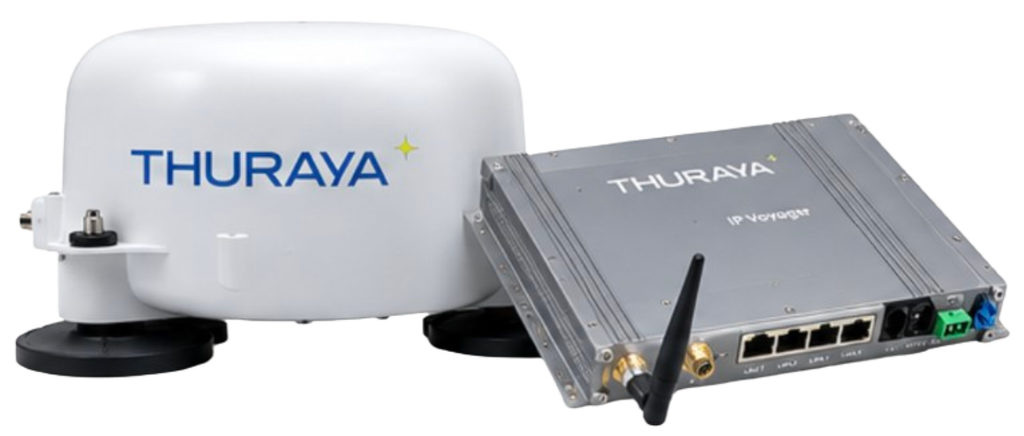
The Thuraya IP Voyager is a dedicated vehicular satellite communication terminal designed to provide broadband IP connectivity while on the move. Developed for communications-on-the-move applications, the system combines a tracking antenna, Below Deck Unit (BDU), wireless connectivity, Power over Ethernet (PoE) ports, and Thuraya satellite connectivity in a compact solution designed for vehicle deployment.
According to the manufacturer’s brochure, Thuraya IP Voyager provides standard IP data rates of up to 444 kbps and streaming IP speeds of up to 384 kbps. It also supports user-configurable asymmetric streaming, allowing bandwidth allocation to be adjusted according to operational requirements.
For organizations operating in locations where terrestrial broadband and cellular networks are unavailable or unreliable, the Thuraya IP Voyager provides an alternative communications path through satellite connectivity.
VSATplus offers the Thuraya IP Voyager for customers requiring mobile satellite connectivity and can assist with sourcing the equipment for professional satellite communication deployments.
Thuraya IP Voyager is a vehicular satellite terminal specifically designed for communications-on-the-move.
Unlike fixed VSAT systems that require a permanently installed antenna and a stationary operating position, a communications-on-the-move terminal is designed to maintain satellite connectivity while the vehicle is traveling.
The system is intended to provide users with access to internet-based services such as:
The manufacturer positions the system for mission-critical applications including border patrol, defense, disaster response, energy operations, government communications, relief operations, and media activities.
The system is particularly useful in areas where conventional cellular or terrestrial networks do not provide adequate coverage.
One of the most important characteristics of Thuraya IP Voyager is its ability to support broadband IP connectivity while traveling.
A vehicle equipped with the system can remain connected to the satellite network while moving through remote areas.
This capability can be particularly valuable for teams that cannot rely on fixed communications infrastructure.
For example, an emergency response team may need to travel between multiple locations while maintaining communication with its headquarters. A television crew may need to transmit information from locations outside cellular coverage. A border patrol vehicle may require continuous communication while operating across large geographic areas.
In these situations, mobile satellite connectivity can provide an independent communications infrastructure.
The Thuraya IP Voyager brochure describes the system as a dedicated vehicular terminal intended for mission-critical on-the-move operations where terrestrial networks are inadequate.
Thuraya IP Voyager supports standard IP connectivity at speeds of up to:
444 kbps
For applications that require more predictable bandwidth characteristics, the terminal supports streaming IP speeds of up to:
384 kbps
The streaming capability is particularly relevant to applications such as video, VoIP, surveillance, and other services where maintaining a consistent data stream can be important.
The brochure specifically identifies the terminal as capable of streaming IP speeds of up to 384 kbps and supports asymmetric streaming.
Although these data rates are modest compared with modern terrestrial broadband services, the key advantage of a satellite terminal such as Thuraya IP Voyager is the ability to provide connectivity in environments where terrestrial broadband may not be available at all.
A particularly useful feature of the Thuraya IP Voyager is asymmetric streaming.
Not every satellite application requires equal upload and download bandwidth.
For example, a field team may primarily download information from a central server while sending a smaller amount of operational data back to headquarters.
Conversely, a media organization transmitting video from a remote location may require substantially more upload capacity.
The asymmetric streaming capability allows users to configure bandwidth according to their operational requirements.
This can help organizations use satellite bandwidth more efficiently and potentially reduce unnecessary communication costs.
The manufacturer describes Thuraya as the first mobile satellite services operator to provide asymmetric streaming capabilities for its broadband devices.
A major advantage of Thuraya IP Voyager is its installation concept.
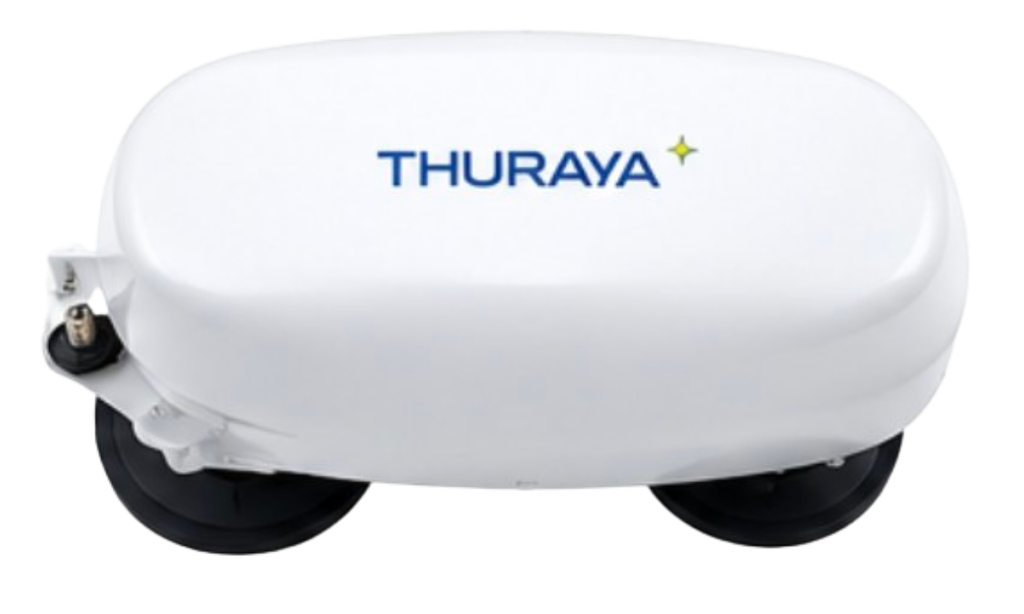
The system is designed specifically for vehicle installation, with the antenna featuring magnetic mounting feet that allow it to be fitted rapidly.
The manufacturer describes the installation process as simple and suitable for swift mission deployment.
This is especially valuable for organizations that operate temporary or rapidly deployable teams.
Instead of requiring extensive infrastructure construction, the terminal can be deployed on a vehicle and connected to the necessary power and communications equipment.
The plug-and-play design also helps reduce installation complexity for field teams.

A communications terminal installed on a vehicle must be able to tolerate vibration and movement.
Thuraya IP Voyager has been designed specifically for vehicular operation. The brochure states that the satellite unit uses a rigid chassis and internal components designed to withstand the vibration associated with vehicle environments.
The antenna has an IP56 ingress protection rating.
This provides protection against dust and water exposure and makes the antenna appropriate for demanding outdoor environments.
The combination of a rugged vehicle-oriented design and IP56-rated antenna allows the system to be considered for field deployments where outdoor equipment can be exposed to environmental conditions.
The antenna is a key component of the system because it provides the satellite RF connection.
The brochure specifies the antenna dimensions as:
252 mm × 119 mm
and its weight as:
2.0 kg
The antenna has an IP56 rating and is designed for vehicular deployment.
The technical documentation also specifies mechanical vibration performance of:
200–2000 Hz, 0.3 m²/s³, MIL-Spec 810B
This specification is particularly relevant for vehicle-mounted equipment because continuous vibration can place mechanical stress on electronic and RF components.
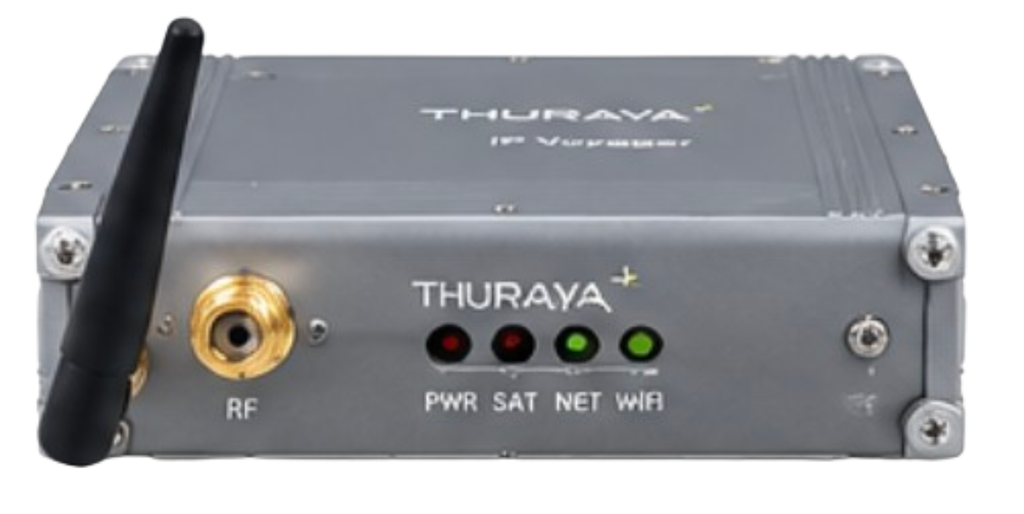
The Thuraya IP Voyager system also includes a Below Deck Unit (BDU).
The BDU provides the internal equipment interface between the antenna and the user’s network devices.
According to the supplied technical specifications, the BDU measures:
46 mm (H) × 281 mm (W) × 233 mm (D)
and weighs:
2.3 kg
The BDU operates from a DC power input of:
10–32 VDC
with maximum power consumption of:
70 W
or:
7 A maximum
This relatively broad DC input range is particularly useful for vehicle installations, where available electrical systems can vary depending on the vehicle platform.
Another important feature of Thuraya IP Voyager is its integrated wireless networking capability.
The system supports:
IEEE 802.11 b/g/n
with:
WPA2 encryption
This allows multiple internet-enabled devices to connect to the terminal without requiring each device to be directly connected to the BDU.
Supported devices can include:
The brochure specifically identifies wireless connectivity to multiple internet-enabled devices as one of the key benefits of the system.
This can be particularly useful for field teams where multiple personnel need simultaneous access to the satellite connection.
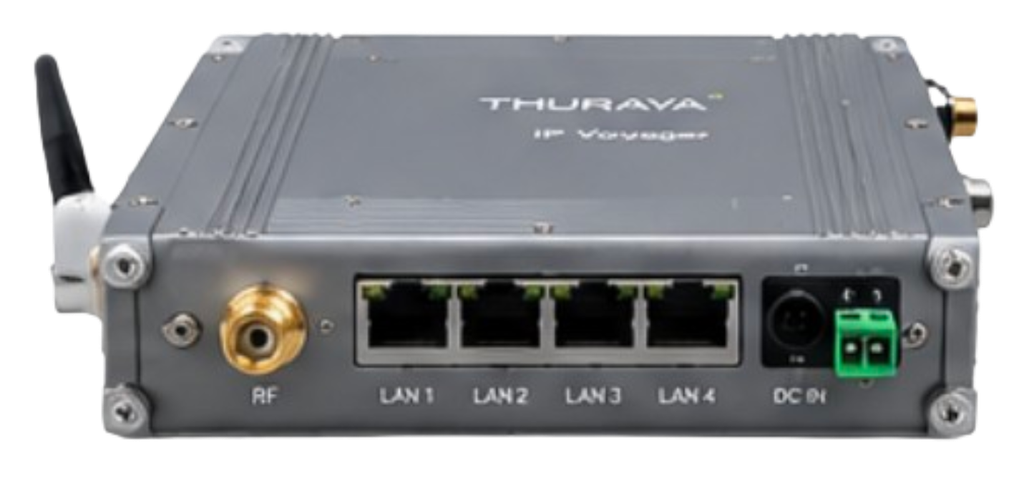
The Thuraya IP Voyager BDU provides:
4 PoE ports
The brochure specifies a maximum PoE power capability of:
30 W maximum for 12 V installations
and:
60 W maximum for 24 V installations.
This provides additional flexibility for connecting compatible network devices and field equipment.
The availability of multiple ports means that the system can serve as more than simply a satellite internet connection. It can form part of a small mobile communications network inside the vehicle.
The Thuraya IP Voyager brochure also highlights an IP Unlimited data plan.
Under this type of service arrangement, users can conduct field operations such as:
at a fixed monthly rate without additional data charges, according to the brochure.
For organizations that use satellite connectivity intensively, predictable communications costs can be an important operational consideration.
Network availability is particularly important for mission-critical satellite communications.
The Thuraya brochure describes its network as using dynamic resource allocation to minimize signal congestion in areas experiencing high communication traffic.
The network can automatically reallocate resources to individual spot beams, helping users maintain connectivity while operating within the Thuraya coverage area.
This approach is intended to support reliable communications even when multiple users are accessing the satellite network.
According to the supplied brochure, Thuraya IP Voyager operates across the Thuraya satellite footprint, which extends across approximately 160 countries in:
This broad coverage makes the system suitable for organizations whose operations extend across multiple countries and regions within the Thuraya footprint.
Coverage availability should always be checked against the specific operational location before deployment.
Government agencies operating in remote areas can use mobile satellite connectivity to maintain communications between vehicles and central operations.
Border patrol operations can also benefit from real-time connectivity for coordination, reporting, surveillance, and situational awareness.
The brochure specifically identifies video surveillance combined with Thuraya IP streaming as a potential solution for border patrol operations.
During natural disasters or major emergencies, terrestrial communication infrastructure can become unavailable or overloaded.
A vehicle equipped with Thuraya IP Voyager can provide an independent communications channel for emergency teams.
The terminal can support applications including VoIP, video conferencing, file transfer, and other IP-based services.
The brochure identifies emergency and disaster response as an important mission-critical application.
Energy companies frequently operate in locations far from conventional communications infrastructure.
Remote energy sites can use satellite connectivity for communications between field personnel and headquarters.
The terminal’s vehicular design also allows teams to maintain connectivity while moving between remote operational locations.
Journalists and field production teams need reliable communications to transmit information from locations where terrestrial networks may be unavailable.
Thuraya IP Voyager can support outside-broadcast workflows and provide IP connectivity for communication between field teams and newsrooms.
The brochure specifically identifies outside broadcasting as a media application.
Satellite connectivity can also support remote medical applications.
The brochure describes telemedicine solutions involving wireless and wearable communication devices capable of transmitting real-time video and supporting communication with medical personnel located elsewhere.
For remote locations, such connectivity can help medical teams communicate with specialists and exchange information.
VoIP provides a practical way for field personnel to communicate with headquarters and other teams through the satellite IP connection.
The brochure identifies VoIP as a key solution for government, energy, leisure, relief, and media sectors.

The major advantages of the Thuraya IP Voyager include:
Provides satellite IP connectivity while operating from a vehicle.
Supports standard IP data rates up to 444 kbps.
Provides streaming IP capability up to 384 kbps.
Allows users to configure upload and download bandwidth according to their application.
Magnetic antenna mounts and plug-and-play functionality support quick deployment.
Designed specifically for vehicular environments and vibration exposure.
Provides protection against dust and water exposure.
Supports IEEE 802.11 b/g/n with WPA2 encryption.
Four PoE ports provide additional connectivity options.
The BDU supports 10–32 VDC, making it suitable for vehicle electrical systems.
Designed for government, defense, disaster response, energy, relief, media, and other remote operations.
Coverage extends across approximately 160 countries within the Thuraya service footprint.
| Specification | Thuraya IP Voyager |
|---|---|
| Product Type | Vehicular satellite IP terminal |
| Application | Communications-on-the-Move |
| Standard IP Data Rate | Up to 444 kbps |
| Streaming IP Data Rate | Up to 384 kbps |
| Streaming | Asymmetric streaming supported |
| Antenna Dimensions | 252 × 119 mm |
| Antenna Weight | 2.0 kg |
| Antenna IP Rating | IP56 |
| Antenna Vibration | 200–2000 Hz, 0.3 m²/s³, MIL-Spec 810B |
| BDU Dimensions | 46 × 281 × 233 mm |
| BDU Weight | 2.3 kg |
| BDU Power Input | 10–32 VDC |
| Maximum BDU Power | 70 W |
| Maximum Current | 7 A |
| PoE Ports | 4 |
| PoE Power – 12 V Installation | 30 W maximum |
| PoE Power – 24 V Installation | 60 W maximum |
| WLAN | IEEE 802.11 b/g/n |
| WLAN Security | WPA2 encryption |
| RF Cable | 6 m supplied |
| Maximum RF Cable Loss | Less than 10 dB at 1.6 GHz |
| Mounting | Magnetic antenna mounts |
| Coverage | Thuraya footprint / approximately 160 countries |
| Main Applications | Government, energy, relief, media, defense, disaster response |
The technical values above are based on the specifications presented in the supplied Thuraya IP Voyager brochure.
The supplied documentation identifies the following items as part of the Thuraya IP Voyager package:
The brochure also notes that the RF cable length can be changed, provided that the total cable loss remains below 10 dB at 1.6 GHz.
This provides flexibility when integrating the terminal into different vehicle configurations.
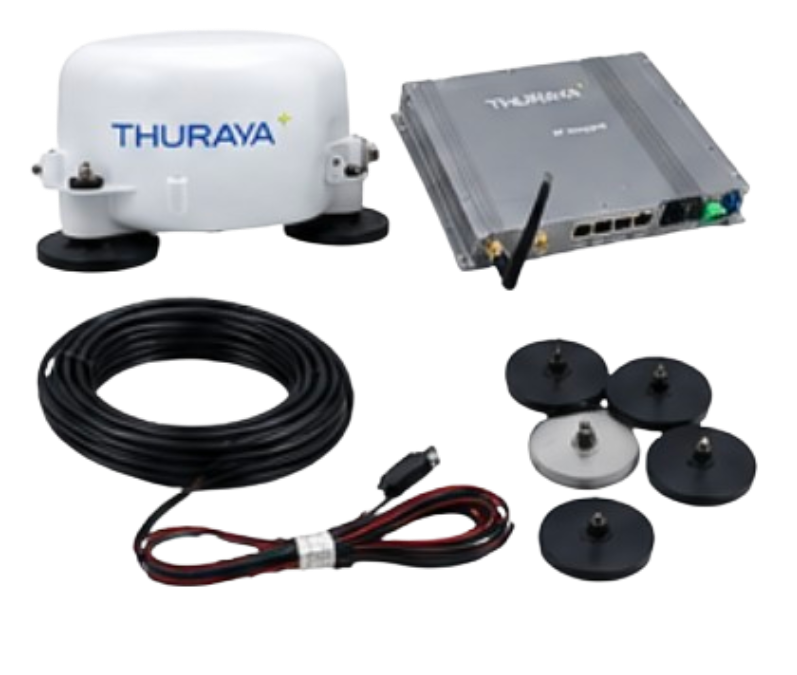
The main strength of Thuraya IP Voyager is not simply its satellite connection. It is the combination of mobility, rapid deployment, broadband IP connectivity, wireless networking, rugged construction, and mission-focused applications.
For a field organization, connectivity needs to remain available as the team moves.
For emergency responders, communications may need to be established quickly.
For media organizations, information may need to be transmitted from locations where terrestrial infrastructure is unavailable.
For government and energy organizations, remote operations may require reliable communication beyond the reach of conventional networks.
Thuraya IP Voyager is designed around these requirements.
Its compact antenna, magnetic mounting system, vehicle-oriented construction, integrated Wi-Fi, PoE connectivity, and support for streaming IP make it a practical communications platform for mobile operations.
For organizations looking for a dedicated satellite communications solution for vehicles and mobile field operations, VSATplus can provide Thuraya IP Voyager and assist customers with sourcing the equipment for their specific deployment requirements.
The terminal can be considered for applications including:
When contacting VSATPlus, customers should provide information about their intended application, vehicle configuration, operational region, required connectivity services, and any specific networking requirements.
The VSATplus team can then help with the appropriate equipment and configuration for the deployment.

The Thuraya IP Voyager is a purpose-built vehicular satellite terminal designed to provide IP connectivity when conventional terrestrial and cellular networks cannot meet operational requirements.
With standard IP speeds of up to 444 kbps, streaming IP speeds of up to 384 kbps, asymmetric streaming, integrated Wi-Fi, four PoE ports, a rugged vehicle-oriented design, and an IP56-rated antenna, the system combines mobility with practical satellite connectivity.
Its applications extend across government, defense, disaster response, energy, relief, media, surveillance, telemedicine, and other mission-critical environments.
The system’s relatively compact antenna, magnetic mounting system, broad DC input range, and plug-and-play architecture also support rapid field deployment.
For organizations that need to remain connected while operating beyond the reach of terrestrial communications, Thuraya IP Voyager provides a dedicated communications-on-the-move platform.
Thuraya IP Voyager is available through VSATPlus. Contact VSATPlus for pricing, availability, and assistance with sourcing the terminal for your mobile satellite communication requirements.