UAE: +971 6 55 222 55 | USA: +1 (833) VSAT 123


In modern satellite communications, the modem is far more than a device that simply converts digital data into a satellite carrier. For demanding applications such as telecom backhaul, ISP infrastructure, mobile networks, government communications, high-speed content delivery, and disaster recovery, the modem must combine high throughput, spectral efficiency, advanced modulation, flexible interfaces, traffic management, and reliable network control.
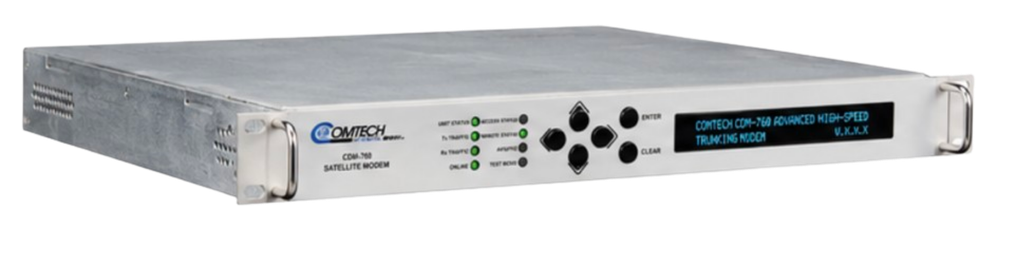
The Comtech CDM-760 Advanced High-Speed Trunking Modem is designed around exactly these requirements. It is a professional satellite modem engineered for high-speed point-to-point trunking applications, offering symbol rates from 100 ksps to 150 Msps and data rates up to 314 Mbps per direction. In duplex operation, the platform can reach an aggregate 628 Mbps, making it particularly suitable for high-capacity satellite links.
For organizations looking to deploy or upgrade a professional satellite network, VSATplus provides the Comtech CDM-760 and can support customers in selecting the appropriate configuration for their satellite, bandwidth, interface, and network requirements.
The CDM-760 is an Advanced High-Speed Trunking Modem designed for efficient transport of IP and other high-speed traffic over satellite.
Unlike basic VSAT modems intended primarily for low- or medium-throughput remote terminals, the CDM-760 is positioned as a high-performance platform for backhaul and trunking applications. The supplied documentation identifies typical users including:
Common applications include:
The modem is designed to maximize the amount of useful information that can be transported through limited satellite spectrum while reducing unnecessary overhead and improving utilization of available transponder power.
This is achieved through a combination of DVB-S2, DVB-S2 Efficiency Boost technology, Adaptive Coding and Modulation, Carrier-in-Carrier, Dynamic Pre-Distortion, advanced packet processing, header compression, QoS, and other technologies.
One of the most important characteristics of the CDM-760 is its extremely wide symbol-rate and data-rate capability.
The modem supports symbol rates from:
100 ksps to 150 Msps
and data rates from approximately:
100 kbps to 314 Mbps
in a single direction.
In a full-duplex configuration, the documentation indicates up to 628 Mbps aggregate throughput or 300 Msps, depending on configuration and operating conditions.
This makes the CDM-760 particularly interesting for satellite backhaul networks where a conventional low-speed VSAT modem may become a bottleneck.
The onboard Gigabit Ethernet architecture can also process extremely high packet rates, with the documentation specifying more than 600,000 packets per second simplex and approximately 1.2 million packets per second duplex for the Ethernet interfaces.
A central feature of the CDM-760 is its support for DVB-S2, the widely adopted high-efficiency satellite transmission standard.
The modem is compliant with ETSI EN 302 307 for DVB-S2 and supports a broad selection of modulation and FEC combinations.
The supported modulation types include:
The modem also supports both normal and short FEC frames:
Pilot insertion can be configured on or off, while DVB-compliant roll-off factors include 20%, 25%, and 35%.
This flexibility allows system engineers to select the appropriate balance between robustness, bandwidth efficiency, and available link margin.
One of the standout technologies in the CDM-760 is DVB-S2-EB1 & EB2 Efficiency Boost.
According to the supplied Comtech documentation, this technology can provide approximately 10% to 35% greater efficiency than conventional DVB-S2, without increasing occupied bandwidth or transmission power.
Comtech_CDM760.pdf
The system achieves this through an expanded selection of MODCODs and additional roll-off factors, including:
The result is greater flexibility in matching the satellite carrier to the actual link conditions.
For satellite operators, increased spectral efficiency can translate into meaningful operational benefits. A more efficient carrier can potentially deliver greater throughput within the same transponder allocation, or achieve a required throughput using less satellite bandwidth.
This is particularly valuable in environments where satellite bandwidth is one of the largest recurring operational costs.
The CDM-760 supports both Adaptive Coding and Modulation (ACM) and Constant Coding and Modulation (CCM).
ACM is especially useful for satellite links where atmospheric conditions can change over time.
Instead of permanently designing the carrier around the worst expected link condition, ACM allows the transmission parameters to adapt according to the actual signal-to-noise conditions.
When conditions are favorable, the system can use a higher-efficiency MODCOD. During degraded conditions, it can move toward a more robust configuration.
The Comtech documentation explains that ACM can convert available link margin into additional user capacity during non-faded conditions by utilizing the actual signal-to-noise ratio instead of designing exclusively around worst-case conditions.
For high-availability networks, this can be an important advantage.

Another major feature is DoubleTalk Carrier-in-Carrier, based on Adaptive Cancellation technology.
Traditional full-duplex satellite communication generally uses separate spectrum for the transmit and receive carriers.
Carrier-in-Carrier allows the two carriers to overlap within the same transponder spectrum. The modem then separates the signals using advanced cancellation technology.
The CDM-760 supports Carrier-in-Carrier symbol rates from:
1 Msps to 63 Msps
with a configurable delay range of:
0–400 ms
and a maximum TX/RX or RX/TX symbol-rate ratio of:
3:1.
The specified degradation at a 0 dB Carrier-in-Carrier ratio varies according to modulation. For example:
| Modulation | Es/No Degradation |
|---|---|
| QPSK | 0.3 dB |
| 8PSK | 0.3 dB |
| 16APSK | 0.4 dB |
| 32APSK | 0.6 dB |
This technology can help satellite operators make more efficient use of limited transponder resources and potentially reduce bandwidth-related operating costs.
Satellite power amplifiers are often most efficient when operated closer to saturation. However, nonlinear amplifier behavior can introduce distortion.
The CDM-760 incorporates Dynamic Pre-Distortion (DPD).
The modem continuously optimizes the pre-distortion process so that the satellite amplifier can operate further toward saturation while maintaining acceptable signal quality. The supplied documentation notes that DPD is designed to maximize transponder efficiency without requiring continuous manual user intervention.
For operators, this means the modem is not only concerned with generating a carrier; it is also designed to optimize how the carrier interacts with the satellite amplifier.
Satellite bandwidth is expensive, so protocol overhead can have a noticeable effect on network efficiency.
The CDM-760 uses Generic Stream Encapsulation (GSE) and can operate with less than 1% encapsulation overhead in Ethernet bridge mode, according to the supplied documentation.
This is particularly useful for high-capacity IP networks where even a small reduction in overhead can translate into meaningful additional payload capacity.
In G.703 synchronous mode, the modem can also implement monitor and control functions over the satellite link without additional overhead.
For IP networking applications, the optional High-Speed Packet Processor significantly expands the CDM-760’s capabilities.
The packet processor can handle:
while simultaneously providing advanced functions such as:
The processor can operate as a Layer 2 managed switch or as a Layer 3 routed device.
One particularly useful function is header compression.
IP packets can contain substantial protocol overhead relative to their payload, particularly for applications such as voice.
The CDM-760 packet processor can reduce an Ethernet/IP/UDP/RTP header from approximately 54 bytes to as little as 1 byte in supported configurations.
The supplied documentation states that VoIP bandwidth savings can exceed 65%, and gives an example where an 8 kbps G.729 voice stream requiring approximately 31.2 kbps after encapsulation could be reduced to around 9 kbps with header compression.
This makes the technology particularly valuable for satellite networks carrying large amounts of voice or other small-packet traffic.
The packet processor also provides sophisticated Quality of Service functionality.
Traffic can be classified using parameters such as:
Up to eight prioritization levels can be configured.
The available traffic-management approaches include:
This allows network operators to protect critical traffic when satellite capacity becomes congested.
For example, an operator could prioritize real-time voice, enterprise applications, control traffic, or mission-critical data above less-sensitive bulk traffic.
The optional packet processor can also operate in Layer 3 routed mode.
The platform supports up to 256 static routes based on destination IP address masks.
Performance in Layer 3 routed mode is specified at more than:
105,000 PPS simplex
and more than:
150,000 PPS duplex.
Comtech_CDM760.pdf
This means the CDM-760 can participate directly in more sophisticated IP network architectures instead of operating only as a simple transparent bridge.
Another optional capability is the K4 GZIP lossless compression engine.
This technology performs real-time compression of user payloads.
According to the supplied documentation, testing against an industry-standard Calgary Corpus profile produced approximately 52%–59% compression.
Actual compression depends heavily on the characteristics of the transmitted data. Highly compressible information can benefit significantly, while already-compressed data such as many video or encrypted streams may offer considerably less benefit.

Satellite interference can be difficult and time-consuming to locate.
The CDM-760 addresses this with MetaCarrier technology and support for DVB-CID according to ETSI TS 103 129.
MetaCarrier embeds a small identification message and unique ID within a video or data carrier. This allows network operators to identify the source of a carrier more quickly when interference occurs.
Comtech_CDM760.pdf
For satellite operators managing multiple carriers, this can be a valuable operational feature.
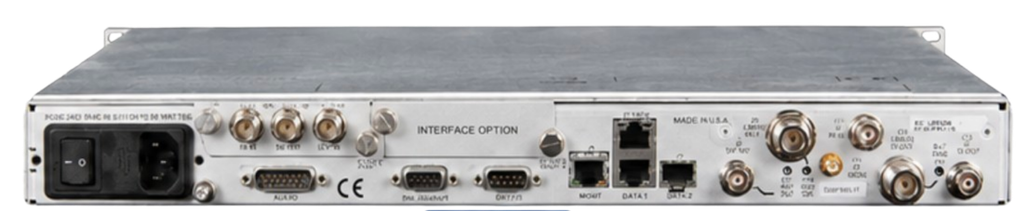
The CDM-760 provides a broad selection of interfaces.
Standard Ethernet connectivity includes:
An optional:
interface is available.
The Ethernet architecture supports Super Jumbo Frames up to 10,240 bytes, including Ethernet header and CRC, when operating in the applicable non-packet-processor configuration.
Comtech_CDM760.pdf
Optional PIIC interface cards expand the system to support legacy and telecom interfaces including:
The G.703 interfaces support:
STM-1 and OC-3 interfaces support approximately 155.52 Mbps.
The CDM-760 is designed to accommodate different satellite RF architectures.
Its dual IF configuration supports:
For 70/140 MHz operation, the modulator frequency range is:
50–180 MHz
with 100 Hz tuning steps.
The L-Band modulator range is:
950–2150 MHz
also with 100 Hz tuning steps.
The demodulator similarly supports 70/140 MHz and L-Band inputs.
For L-Band, the demodulator operates from 950 to 2150 MHz, using a 50-ohm Type-N female interface.
Professional satellite networks require more than basic local configuration.
The CDM-760 supports several management methods, including:
The modem also provides a reflash Ethernet management port.
For centralized network operations, these capabilities can make integration into an existing Network Operations Center considerably easier.
The modem supports in-band monitor and control over satellite, allowing operators to manage equipment remotely in appropriate network architectures.
Accurate frequency control is critical in high-performance satellite networks.
The CDM-760 specifies internal frequency stability of:
±0.06 ppm
The external reference interface uses BNC female connectors and supports reference frequencies including:
The internal reference can also be used for IF and data, with the modem internally phase-locking the relevant signals.

The following table summarizes the principal specifications contained in the supplied Comtech CDM-760 documentation.
| Specification | CDM-760 |
|---|---|
| Product Type | Advanced High-Speed Trunking Modem |
| DVB Standard | DVB-S2, ETSI EN 302 307 |
| Efficiency Boost | DVB-S2-EB1 & EB2 |
| Symbol Rate | 100 ksps – 150 Msps |
| Maximum Data Rate | Up to 314 Mbps |
| Duplex Aggregate Rate | Up to 628 Mbps |
| Modulation | QPSK, 8PSK, 16APSK, 32APSK |
| FEC Frame | Normal 64,800 bits / Short 16,200 bits |
| Pilots | On / Off |
| DVB Roll-Off | 20%, 25%, 35% |
| EB Roll-Off | 5%, 10%, 15%, 20%, 25%, 35% |
| ACM | Supported |
| CCM | Supported |
| Carrier-in-Carrier | DoubleTalk |
| Carrier-in-Carrier Symbol Rate | 1–63 Msps |
| Carrier-in-Carrier Delay | 0–400 ms |
| DPD | Supported |
| AUPC | Optional |
| DVB-CID | ETSI TS 103 129 |
| GSE Overhead | <1% in Ethernet bridge mode |
| Packet Processor | Optional |
| Packet Processor Rate | >190k PPS simplex / >350k PPS duplex |
| Layer 3 Static Routes | Up to 256 |
| Ethernet | 2 × 10/100/1000Base-T |
| Optical Ethernet | Optional Gigabit |
| Super Jumbo Frames | Up to 10,240 bytes |
| 70/140 MHz IF | 50–180 MHz |
| L-Band | 950–2150 MHz |
| Frequency Stability | ±0.06 ppm |
| Management | SNMP, HTTP, Telnet, RS-232/485 |
| G.703 | E3/T3/STS-1 optional |
| STM-1 | 155.52 Mbps optional |
| OC-3 | 155.52 Mbps optional |
| Operating Temperature | 0°C to +50°C |
| Storage Temperature | -40°C to +70°C |
| Humidity | 95% maximum, non-condensing |
| AC Input | 100–240 VAC, 50/60 Hz |
| DC Input | 43–60 VDC |
| Typical Power | Approx. 88 W AC |
| Dimensions | 1.75 × 19 × 18.65 in |
| Rack Format | 1RU |
| Weight | 15 lb / 6.8 kg |
| Agency Compliance | CE Mark, FCC Part 15 |
These specifications are based on the supplied CDM-760 documentation; optional features and interfaces depend on the specific modem configuration.
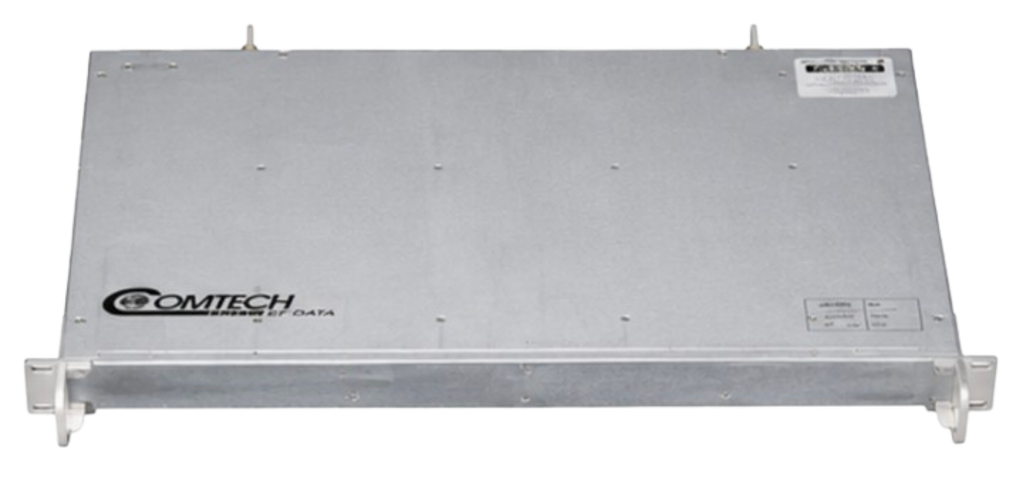
The CDM-760 is designed as a 1RU rack-mount modem, making it appropriate for professional network facilities, teleport environments, satellite gateways, and communications infrastructure.
Its dimensions are:
1.75 × 19 × 18.65 inches
or approximately:
48 × 47.4 × 4.4 cm
The weight is approximately:
15 lb / 6.8 kg.
Comtech_CDM760.pdf
The operating temperature range is:
0°C to +50°C
while storage temperature extends from:
-40°C to +70°C.
Maximum specified humidity is 95%, non-condensing.
Power options include 100–240 VAC at 50/60 Hz and 43–60 VDC, with a 48 VDC option.
Typical AC power consumption is approximately 88 W.
With data rates up to 314 Mbps per direction, the CDM-760 is designed for significantly higher-capacity applications than conventional remote VSAT modems.
Comtech_CDM760.pdf
DVB-S2-EB1/EB2 can provide significant efficiency improvements over conventional DVB-S2.
Carrier-in-Carrier, GSE, header compression, ACM and optional payload compression provide multiple mechanisms for reducing satellite resource requirements.
The optional packet processor provides QoS, VLAN, MPLS, header compression and Layer 3 routing.
Gigabit Ethernet, L-Band, 70/140 MHz, G.703, STM-1 and OC-3 options allow the modem to integrate into different generations of satellite and telecom infrastructure.
SNMP, HTTP, Telnet, RS-232/485 and in-band management support make the platform appropriate for remotely managed network environments.
The platform supports both 1:1 and 1:N modem redundancy configurations, which can be important for carrier-grade services where downtime must be minimized.
The CDM-760 is particularly well suited to:
Telecom Backhaul:
High-capacity satellite links can connect remote cellular and telecommunications infrastructure where terrestrial fiber is unavailable or unreliable.
ISP Backhaul:
ISPs can use the modem for high-throughput Internet trunking and remote gateway connectivity.
Government and Defense Communications:
Its high capacity, advanced modulation, monitoring, redundancy, and efficient use of satellite resources make it suitable for demanding government and mission-critical networks.
Disaster Recovery:
Satellite links can provide an alternative communications path when terrestrial infrastructure is damaged.
High-Speed Content Distribution:
Large volumes of digital content can be transported efficiently over satellite.
G.703 and Legacy Telecom Networks:
Optional telecom interfaces allow integration with established synchronous network infrastructure.
The biggest strength of the CDM-760 is not any single specification. It is the combination of technologies integrated into one platform.
A high-capacity satellite network may face several limitations simultaneously: limited transponder bandwidth, amplifier nonlinearity, changing weather conditions, packet overhead, QoS requirements, interference, and the need to integrate with different network interfaces.
The CDM-760 addresses these challenges through a combination of DVB-S2, Efficiency Boost, ACM, Carrier-in-Carrier, DPD, packet processing, QoS, compression, DVB-CID and flexible interfaces.
That combination makes it particularly relevant when the objective is not simply to establish a satellite link, but to maximize the efficiency and operational value of that link.
For satellite operators, telecom companies, ISPs, system integrators, government organizations and businesses requiring high-performance satellite trunking equipment, the Comtech CDM-760 Advanced High-Speed Trunking Modem represents a powerful platform for high-capacity satellite networking.
VSATplus offers the Comtech CDM-760 for professional satellite communication applications and can assist customers in determining the appropriate configuration based on the required modulation, symbol rate, IF interface, Ethernet requirements, packet-processing capabilities and network architecture.
Because several CDM-760 capabilities are optional, customers should specify their intended application and required interfaces when requesting a quotation.
Contact VSATplus for pricing, availability, configuration and ordering information for the Comtech CDM-760.
The Comtech CDM-760 Advanced High-Speed Trunking Modem is designed for organizations that need considerably more from a satellite modem than basic connectivity.
With support for 100 ksps to 150 Msps symbol rates, data rates up to 314 Mbps, advanced DVB-S2 waveforms, DVB-S2 Efficiency Boost, QPSK through 32APSK modulation, ACM/CCM, Carrier-in-Carrier, Dynamic Pre-Distortion, packet processing, QoS, header compression, GSE, DVB-CID and multiple high-speed interfaces**, the CDM-760 provides a comprehensive platform for professional satellite trunking.
Its 1RU form factor, Gigabit Ethernet connectivity, L-Band and 70/140 MHz support, optional telecom interfaces, extensive management capabilities and redundancy options further strengthen its position as a professional infrastructure modem.
For telecom backhaul, ISP trunking, government communications, high-speed content delivery, emergency communications and other demanding satellite applications, the CDM-760 offers the combination of throughput, spectral efficiency, networking flexibility and satellite resource optimization required for modern high-capacity networks.
The Comtech CDM-760 is available from VSATplus. Contact VSATplus today to discuss your requirements and order the appropriate configuration for your satellite network.