UAE: +971 6 55 222 55 | USA: +1 (833) VSAT 123


Efficient RF signal distribution is essential in professional satellite communication networks, broadcast infrastructure, telecommunications facilities, and RF distribution systems. As networks expand, operators frequently need to combine multiple RF signals into a single output while maintaining signal quality, minimizing insertion loss, and ensuring reliable system performance.
The Quintech LC 1000A Series Active Broadband Combiners provides a professional solution for these requirements. Manufactured by Quintech Electronics & Communications, the LC 1000A family consists of commercial-quality active broadband RF combiners designed to combine multiple RF inputs across a frequency range of 5–1000 MHz.
Available in three configurations – LC16 1000A, LC32 1000A, and LC64 1000A – the series supports 16-way, 32-way, and 64-way RF combining applications. These systems are designed to meet demanding signal-level, impedance-matching, and insertion-loss requirements using Quintech’s proprietary technology.
One of the most important characteristics of the LC 1000A Series is its active, zero-loss combining architecture. Unlike conventional passive combining arrangements that can introduce substantial signal loss, active combining helps simplify RF system design and reduces the need for additional amplification stages.
The centralized rack-mount construction also improves cable organization, simplifies maintenance, and reduces the risk of connector failures caused by frequent manual connections and disconnections.
For satellite communication operators, broadcast facilities, RF engineers, and telecommunications infrastructure providers, the Quintech LC 1000A Series offers a flexible solution for managing multiple RF signals in a professional rack-mounted environment.
VSATPlus offers professional satellite communication and RF distribution equipment, including Quintech solutions. Contact VSATPlus to inquire about the LC 1000A Series, available configurations, pricing, and ordering options.
The Quintech LC 1000A Series is a family of active broadband RF combiners designed to combine multiple input signals into a single RF output.
The series is intended for applications where several RF sources need to be brought together and distributed through a common downstream signal path.
For example, a satellite ground station or telecommunications facility may receive RF signals from multiple modulators or external feeds. Instead of connecting every source through a complicated arrangement of individual cables and passive combining components, an LC 1000A system provides a centralized combining platform.
The product family includes three principal models:
The different configurations allow system designers to select a model according to the number of RF sources, rack-space requirements, and signal-distribution architecture.
All three models operate across the specified 5–1000 MHz frequency range and provide an insertion-loss specification of 0 ± 2 dB at 500 MHz.
According to the manufacturer’s documentation, the LC 1000A Series uses Quintech proprietary technology to meet demanding level, matching, and loss specifications. Custom configurations are also available.
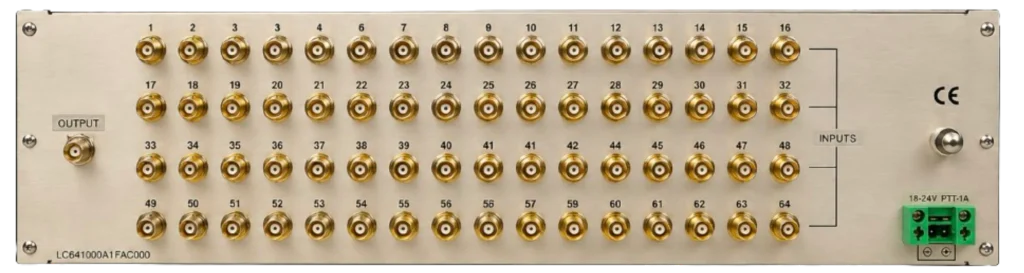
The LC16 1000A is the 16-input configuration within the product family.
It combines up to 16 RF input signals into one output and is designed for installations with a relatively moderate number of RF sources.
Its compact 1RU rack-mount construction makes it suitable for facilities where rack space is limited.
With a maximum specified P1dB of +8 dBm per input, the LC16 1000A provides the highest per-input P1dB rating among the three configurations listed in the datasheet.
Key characteristics:
The LC16 1000A is suitable for smaller RF distribution systems that require centralized signal combining without the additional rack-space requirements of larger models.
The LC32 1000A is designed for installations requiring a larger number of RF input connections.
It supports 32 RF inputs combined into one output, making it appropriate for more extensive signal distribution systems.
Its 2RU rack-mount configuration provides additional capacity while maintaining a centralized equipment arrangement.
The manufacturer’s datasheet specifies a P1dB of +1 dBm per input, with the value identified as a single-carrier equivalent.
Key characteristics:
The LC32 1000A offers a useful balance between input capacity and rack-space requirements for medium-sized RF distribution facilities.
The LC64 1000A is the highest-capacity configuration in the series.
It supports 64 RF inputs combined into a single output, making it suitable for large-scale installations involving numerous modulators, RF sources, or external feeds.
Its 3RU rack-mount design provides a centralized location for a high number of RF connections.
The datasheet specifies a P1dB of -2.0 dBm per input for this model.
Key characteristics:
For large RF distribution systems, the LC64 1000A can help simplify cable routing and reduce the need for multiple cascaded combining stages.
The LC 1000A Series operates across a frequency range of 5–1000 MHz.
This broad operating range makes it suitable for compatible broadband RF distribution applications that require combining signals across a wide range of frequencies.
The operating bandwidth provides flexibility when integrating different RF sources into a common distribution architecture.
It is important to note that the LC 1000A Series is a broadband RF combiner, not a satellite-band IF combiner covering the full 950–2150 MHz range. Engineers should verify frequency compatibility before selecting it for a particular satellite system.
One of the defining features of the LC 1000A Series is its active combining architecture.
Quintech describes these products as active, zero-loss combiners designed to simplify RF engineering.
The specified insertion loss is 0 ± 2 dB at 500 MHz across the three models.
This characteristic helps reduce the need to compensate for the substantial signal attenuation typically associated with passive combining arrangements.
For RF system designers, this can simplify link-budget calculations and equipment selection.
The manufacturer identifies its microstrip design as an important feature of the LC 1000A Series.
According to Quintech, this design provides improved performance and reliability.
The microstrip implementation is part of the manufacturer’s approach to achieving the required RF characteristics across the operating frequency range.
The LC 1000A family is available in 16-way, 32-way, and 64-way configurations.
This allows customers to select the appropriate capacity for their installation rather than relying on several smaller combiners connected in sequence.
The manufacturer specifically highlights that larger configurations can eliminate cascading, helping improve system performance.
Reducing the need for cascading can also simplify cable management and equipment organization.
Cable organization is a major consideration in professional RF installations.
As the number of connected RF sources increases, managing individual cables and connections can become difficult.
The LC 1000A Series uses a centralized rack-mounted design to improve cable routing, access, and identification.
This is particularly useful in telecommunications facilities, satellite ground stations, and broadcast environments where equipment may need to be inspected or maintained regularly.
Frequent manual connection and disconnection can increase connector wear and the possibility of connection failures.
Quintech highlights that the centralized design reduces the need for frequent manual connects and disconnects.
This can help improve the long-term maintainability of an RF distribution installation.
The manufacturer states that custom configurations are available.
This is useful for organizations with specific RF distribution requirements that may not be fully addressed by the standard LC16, LC32, or LC64 configurations.
Customers should contact VSATPlus to discuss their required configuration and confirm availability.
These features and benefits are described in the manufacturer’s product documentation.

The LC 1000A Series provides several operational advantages for professional RF distribution environments.
1. Simplified RF System Design
Active zero-loss combining helps reduce the need for extensive signal-loss compensation and can simplify RF engineering.
2. Multiple Capacity Options
The availability of 16-way, 32-way, and 64-way configurations allows the product to accommodate different installation sizes.
3. Reduced Cascading Requirements
Larger configurations can eliminate the need to cascade multiple smaller combiners, helping simplify the signal path.
4. Better Cable Organization
Centralized rack-mount construction provides a more organized environment for RF connections.
5. Improved Maintenance Accessibility
Clearly organized connections make it easier for technicians to identify and access individual RF cables.
6. Reduced Connector Handling
Less frequent manual connection and disconnection can help reduce connector wear and potential failures.
7. Professional Rack Integration
The 1RU, 2RU, and 3RU designs allow the equipment to be integrated into standard 19-inch rack environments.
8. Flexible Configuration Options
Custom configurations provide additional flexibility for specialized installations.
Together, these advantages make the LC 1000A Series a practical option for professional facilities that need to combine multiple RF signals through a centralized broadband distribution system.
Satellite ground stations often contain multiple RF sources and equipment channels that need to be integrated into a common distribution path.
The LC 1000A Series can be used to combine compatible RF outputs from multiple sources into one downstream feed.
Its different input capacities allow operators to select a model according to the number of signals in their installation.
Potential applications include:
Telecommunications facilities frequently manage multiple RF sources that must be combined and routed through organized distribution systems.
The LC 1000A Series can provide centralized combining for compatible signals within its 5–1000 MHz operating range.
The rack-mounted design is particularly useful in facilities where equipment density and cable organization are important.
Broadcast facilities may need to combine signals from multiple modulators or RF sources.
The LC 1000A Series can provide a centralized combining point for compatible broadband signals.
The LC32 and LC64 models are particularly relevant when installations require a larger number of input connections.
The manufacturer’s product diagram illustrates multiple modulators feeding an LC1000A combiner, with the combined trunk feeds directed downstream.
This illustrates a typical application in which multiple modulator outputs and external RF feeds are brought together through a common combining unit.
The configuration helps reduce the need for a complex arrangement of separate combining components.
The LC 1000A Series can be integrated into compatible RF distribution networks that require several sources to be combined before downstream distribution.
Potential applications include:
The exact suitability depends on operating frequency, input power, impedance, connector type, and the requirements of the complete RF system.
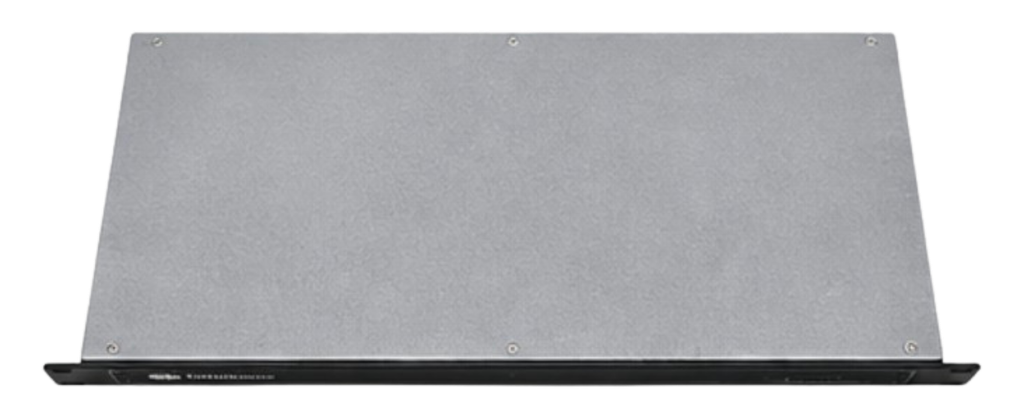
The following tables summarize the technical specifications published in the Quintech LC 1000A Series datasheet.
| Specification | LC16 1000A | LC32 1000A | LC64 1000A |
|---|---|---|---|
| Product Type | Active Broadband Combiner | Active Broadband Combiner | Active Broadband Combiner |
| Configuration | 16 × 1 | 32 × 1 | 64 × 1 |
| RF Inputs | 16 | 32 | 64 |
| RF Outputs | 1 | 1 | 1 |
| Operating Frequency | 5–1000 MHz | 5–1000 MHz | 5–1000 MHz |
| Frequency Response | ±2.5 dB | ±2.5 dB | ±2.5 dB |
| RF Connector Options | F-Type, BNC 75 Ω | F-Type, BNC 75 Ω | F-Type, BNC 75 Ω |
| Impedance | 75 Ω, 50 Ω | 75 Ω, 50 Ω | 75 Ω, 50 Ω |
| Specification | LC16 1000A | LC32 1000A | LC64 1000A |
|---|---|---|---|
| P1dB | +8 dBm Each Input | +1 dBm Each Input* | -2.0 dBm Each Input |
| Input Return Loss | 14 dB | 12 dB | 17 dB |
| Output Return Loss | 7 dB | 12 dB | 12 dB |
| Insertion Loss | 0 ± 2 dB @ 500 MHz | 0 ± 2 dB @ 500 MHz | 0 ± 2 dB @ 500 MHz |
| Isolation | 16 dB | 16 dB | 20 dB |
The LC32 P1dB specification is identified by the manufacturer as a single-carrier equivalent.
These specifications are particularly important when designing RF systems because they determine how the combiner interacts with input signals and the downstream distribution path.
The input P1dB values should be considered when evaluating signal levels and the potential for compression. Input return loss, output return loss, and isolation are also important when assessing matching and interaction between connected RF sources.
| Specification | LC16 1000A | LC32 1000A | LC64 1000A |
|---|---|---|---|
| Power Requirement | 18–24 V DC | 18–24 V DC | 18–24 V DC |
| Power Connector | 2-Pin Quick Connect Barrier Strip | 2-Pin Quick Connect Barrier Strip | 2-Pin Quick Connect Barrier Strip |
| Power Consumption | 14 W | 17 W | 24 W |
All three models use an 18–24 V DC power supply through a two-pin quick-connect barrier strip.
The manufacturer notes that an AC adapter is sold separately. Customers should confirm the appropriate power arrangement when ordering.
| Specification | LC16 1000A | LC32 1000A | LC64 1000A |
|---|---|---|---|
| Rack Height | 1 RU | 2 RU | 3 RU |
| Height | 1.75 in | 3.5 in | 5.25 in |
| Width | 19 in | 19 in | 19 in |
| Depth | 6.5 in | 14 in | 20 in |
| Rack Format | 19-inch | 19-inch | 19-inch |
The three configurations share a standard 19-inch rack width but differ in height and depth.
The LC16 is the most compact option, while the LC64 provides the highest input capacity and requires the greatest rack space.
Manufacturer specification note: Quintech states that specifications may vary with connector type and recommends consulting the individual specification sheet for specific performance data. Additional configurations and powering options are available on request.
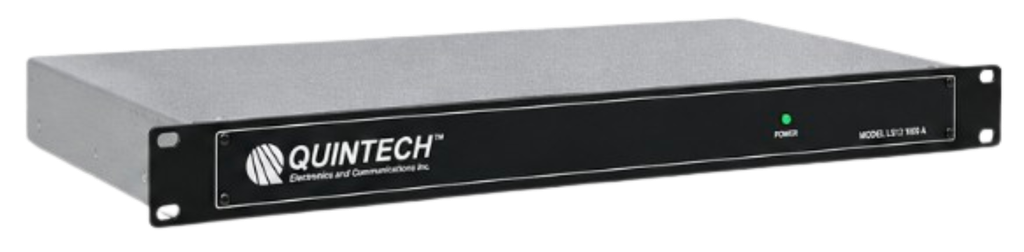
Selecting the right LC 1000A model depends on the number of RF sources, available rack space, input power levels, and the overall distribution architecture.
| Requirement | Recommended Model | Reason |
|---|---|---|
| Up to 16 RF inputs | LC16 1000A | Compact 1RU configuration |
| Up to 32 RF inputs | LC32 1000A | Medium-capacity 2RU configuration |
| Up to 64 RF inputs | LC64 1000A | High-capacity 3RU configuration |
| Limited rack depth | LC16 1000A | Shortest listed chassis depth |
| Higher number of RF sources | LC64 1000A | Largest input capacity |
| Custom RF distribution | Contact VSATPlus | Confirm available custom configurations |
When choosing a model, engineers should also consider the individual input P1dB specification, input and output return loss, isolation, and power requirements.
The number of inputs alone should not determine the selection. The actual RF signal levels and system design requirements must also be considered.
Before installing a Quintech LC 1000A combiner, system designers should review several important requirements.
Frequency compatibility: Confirm that all connected signals operate within the specified 5–1000 MHz frequency range.
Input signal levels: Ensure that the signal levels remain appropriate for the model’s specified P1dB rating.
Impedance matching: Confirm whether the installation requires a 50 Ω or 75 Ω configuration.
Connector compatibility: Verify the required F-Type or BNC connector arrangement. The manufacturer notes that specifications can vary depending on connector type.
Power requirements: Provide the required 18–24 V DC supply through the two-pin quick-connect barrier strip.
Rack installation: Confirm that the rack has sufficient height and depth for the selected model.
Downstream compatibility: Ensure that the combined output is suitable for the connected downstream equipment.
Power accessories: Remember that the AC adapter is sold separately according to the manufacturer’s datasheet.
For specialized installations, Quintech also identifies custom configurations as available. Customers should confirm the required arrangement with VSATPlus before ordering.

The Quintech LC 1000A Series Active Broadband Combiners provides a professional solution for combining multiple RF signals in satellite communications, telecommunications, broadcast, and broadband RF distribution systems.
With 16-way, 32-way, and 64-way configurations, the series offers flexibility for installations of different sizes.
Its active zero-loss architecture, 5–1000 MHz operating range, microstrip design, centralized rack mounting, and reduced cascading requirements make it a useful option for RF engineers and system integrators.
At VSATPlus, customers can inquire about professional RF distribution equipment and satellite communication products for their infrastructure requirements.
Whether you need a compact 16-input combiner, a 32-input solution, or a high-capacity 64-input configuration, VSATPlus can help you check product availability and identify the appropriate model for your installation.
Looking for the Quintech LC16 1000A, LC32 1000A, or LC64 1000A Active Broadband Combiner?
Contact VSATPlus for:
Website: www.vsatplus.com
Email: sales@vsatplus.com
Request a quote from VSATPlus today and find the right Quintech active broadband combiner for your RF distribution network.