UAE: +971 6 55 222 55 | USA: +1 (833) VSAT 123

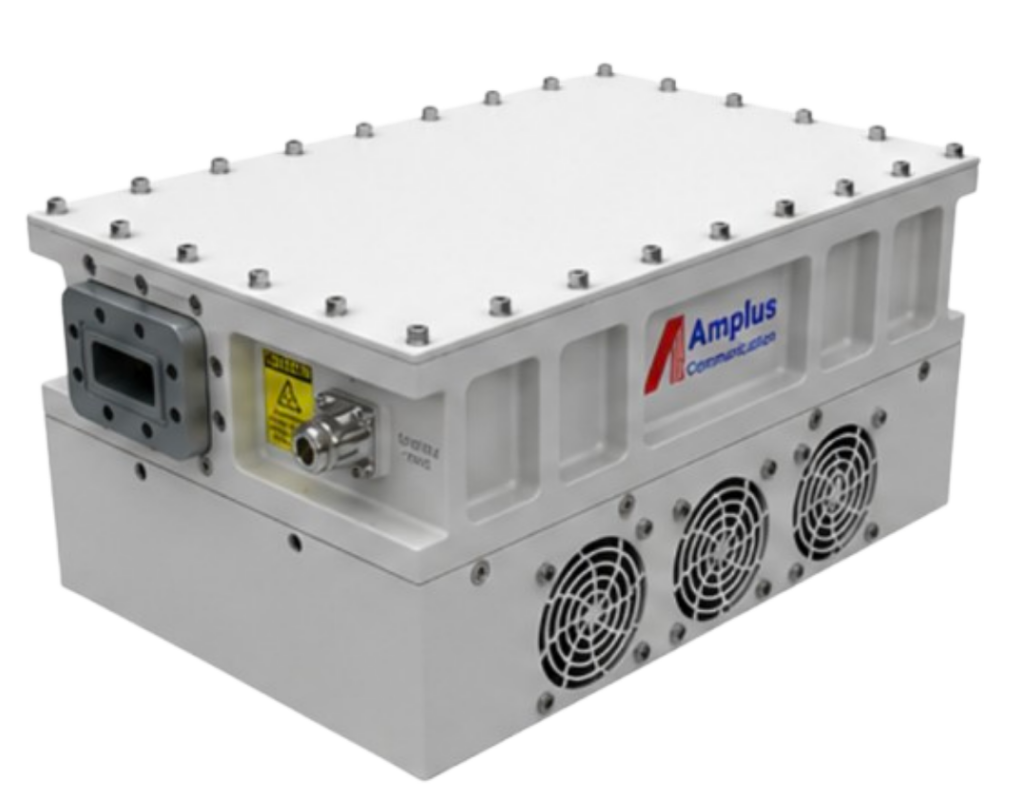
Reliable satellite communication depends on more than a modem and antenna. In demanding VSAT deployments, the Block Upconverter (BUC) is one of the most important components in the transmit chain because it converts the intermediate-frequency signal into the required RF frequency and provides the power needed for transmission toward the satellite.
The Amplus AM-9338 Series C-Band BUC is designed as a high-power, all-in-one outdoor BUC platform for critical VSAT networks. Available in 40W, 50W, 60W, 80W, and 100W power configurations, the AM-9338 combines high RF output power, monitoring and control capabilities, environmental protection, frequency stability, and field-serviceable cooling into a single package.
According to the manufacturer’s datasheet, the series is specifically positioned as an “All-In-One Package for Crucial VSAT Networks.” It is manufactured by Amplus Communication, a company focused on VSAT equipment design, engineering, and manufacturing in Southeast Asia.
For satellite operators, service providers, teleport operators, enterprise networks, government communications, and other organizations requiring dependable C-Band transmission, the AM-9338 provides a practical high-power amplification and frequency-conversion solution.
The AM-9338 Series C-Band BUC is available through VSATPlus, where customers can request pricing, availability, and configuration information.
The AM-9338 is a C-Band Block Upconverter designed for high-power satellite transmission systems.
A BUC typically performs two fundamental functions in a VSAT transmit chain:
The AM-9338 takes this concept further by integrating the BUC functionality into a high-power outdoor unit with monitoring, control, environmental protection, cooling, and multiple reference-frequency options.
The series is available in five output-power classes:
The corresponding P-1dB output power ratings are 46 dBm, 47 dBm, 48 dBm, 49 dBm, and 50 dBm, respectively.
This range allows system designers to select a power level according to link-budget requirements rather than using a single fixed-power amplifier for every installation.
The primary advantage of the AM-9338 is its high RF output capability.
The series supports output powers from 40W through 100W, making it suitable for VSAT applications where the transmit link requires substantially more RF power than typical low-power BUCs.
The manufacturer specifies:
| Model Power | P-1dB Output |
|---|---|
| 40W | 46 dBm |
| 50W | 47 dBm |
| 60W | 48 dBm |
| 80W | 49 dBm |
| 100W | 50 dBm |
The availability of multiple power levels is useful when engineering a satellite link because the required transmit power depends on factors such as antenna size, modulation, coding, bandwidth, satellite transponder characteristics, and link-margin requirements.
The AM-9338 is described by Amplus as an integrated BUC designed to improve performance and reliability.
Rather than treating the frequency conversion, amplification, monitoring, and control functions as separate pieces of equipment, the AM-9338 packages these capabilities into a single outdoor unit.
This approach can simplify system architecture and installation while reducing the number of separate components required in the transmit chain.
For professional VSAT installations, this integrated approach can also make maintenance and system management more straightforward.
One of the most important technical considerations when selecting a C-Band BUC is the exact RF frequency range.
The AM-9338 Series supports multiple C-Band configurations according to the manufacturer’s frequency table.
| Configuration | RF Frequency (MHz) | IF Frequency (MHz) | LO Frequency (MHz) |
|---|---|---|---|
| Standard C | 5850–6425 | 950–1525 | 7375 / 4900 |
| Ext-Palapa | 6365–6725 | 1075–1435 | 7800 / 5290 |
| Extended C | 6425–6725 | 950–1250 | 7675 / 5475 |
| Full C | 5850–6725 | 950–1825 | 7675 / 4900 |
| Insat C | 6725–7025 | 965–1265 | 5760 |
| Insat C (Inverted) | 6725–7025 | 1150–1450 | 8175 |
These frequency options are important because C-Band satellite networks can operate across different allocations depending on the satellite, region, network architecture, and regulatory environment.
Before purchasing, the required RF and IF configuration should therefore be matched against the satellite transponder and modem specifications.
The AM-9338 is designed for stable, high-power RF transmission.
The datasheet specifies a nominal gain of 80 dB, with typical gain flatness of ±2 dB and gain stability over temperature of ±2 dB.
The unit also provides a 20 dB gain-control range, giving system operators additional flexibility when adjusting transmit output levels.
| Parameter | Specification |
|---|---|
| Gain | 80 dB nominal |
| Gain Flatness | ±2 dB typical |
| Gain Stability over Temperature | ±2 dB |
| Gain Control Range | 20 dB |
| Intermodulation Product | -25 dBc max |
| Spurious | -55 dBc max |
| Input VSWR | 1.5:1 max |
| Output VSWR | 1.3:1 max |
The intermodulation specification is given as -25 dBc maximum RF output power with 3 dB total back-off from rated power.
This is particularly relevant in multi-carrier or high-power satellite applications, where nonlinear distortion and intermodulation products can affect adjacent carriers and overall transponder performance.

Frequency stability is critical in satellite communication systems because the transmitted carrier must remain within the required frequency tolerance.
The AM-9338 specifies internal-reference frequency stability of:
±0.02 ppm over temperature
The unit can also operate with an external 10 MHz reference.
The datasheet specifies an external reference level of -5 to +5 dBm. The external 10 MHz reference can be supplied through the L-band cable.
An optional internal 10 MHz reference is also available, together with an automatic external-reference detector. According to the datasheet, when the external reference level falls below 0 dBm nominal, the unit automatically switches to its internal reference.
This reference architecture provides flexibility for networks where the BUC needs to synchronize with a centralized frequency reference.
Phase noise is another important characteristic for satellite RF equipment, particularly in systems using high-order modulation or requiring strict carrier-quality performance.
The AM-9338 datasheet provides the following maximum phase-noise values:
| Offset Frequency | Phase Noise |
|---|---|
| 100 Hz | -63 dBc/Hz max |
| 1 kHz | -73 dBc/Hz max |
| 10 kHz | -83 dBc/Hz max |
| 100 kHz | -93 dBc/Hz max |
These specifications characterize the frequency stability and spectral purity of the RF signal generated by the BUC.
For professional satellite networks, maintaining good phase-noise performance helps protect the quality of the transmitted carrier and minimize unwanted spectral effects.
One of the stronger features of the AM-9338 is its built-in monitoring and control capability.
The manufacturer specifies monitoring of:
The control functions include:
The standard PC interface is RS-232/485, while TCP/IP is available as an option. FSK monitoring and control is also available as an optional interface. A handheld terminal using RS-232 is another available option.
This makes the AM-9338 more suitable for managed satellite networks where operators need visibility into the health and performance of outdoor RF equipment.
For larger installations, remote monitoring can be particularly valuable because technicians may not need to physically access the BUC simply to check status or operating parameters.
The AM-9338 incorporates a three-color LED status indicator designed to provide an immediate visual indication of operating condition.
| LED Color | Status |
|---|---|
| Green | Normal |
| Red | Fault |
| Blue | PA Off |
This is a simple but practical feature for field technicians. A quick visual inspection can immediately indicate whether the unit is operating normally, has reported a fault, or has its power amplifier switched off.
Outdoor satellite equipment must operate in environments where temperature, moisture, dust, and weather can become significant operational factors.
The AM-9338 is specified with an IP65 water-proof standard.
Its environmental operating specifications are:
The IP65 enclosure and wide operating-temperature specification make the platform suitable for outdoor VSAT deployments where equipment cannot be installed in a controlled indoor environment.
This is especially relevant for remote satellite terminals, teleport infrastructure, enterprise VSAT networks, and other outdoor installations.
High-power RF equipment naturally generates heat, and thermal management is therefore critical to maintaining reliable operation.
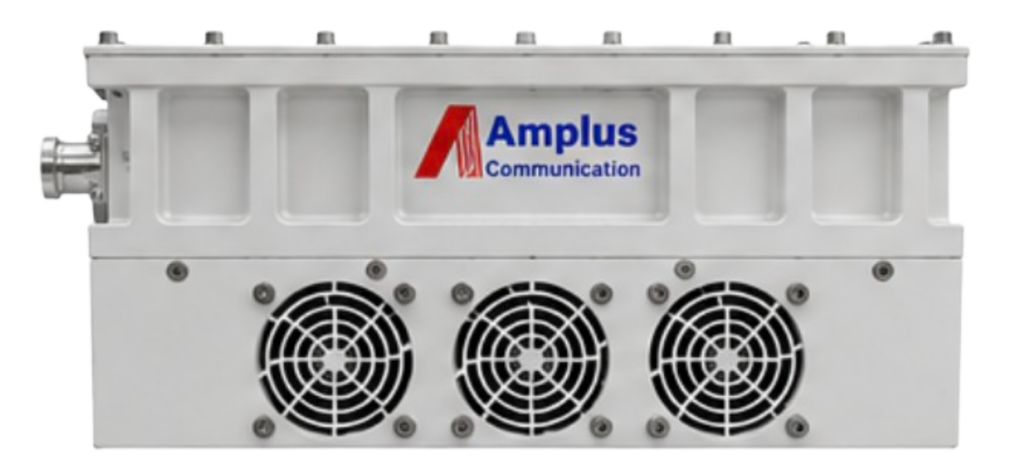
The AM-9338 incorporates field-removable fans.
This feature is valuable from a maintenance perspective because technicians can replace the cooling fans in the field without necessarily removing the complete BUC from service or sending the equipment back to a repair facility.
For remote installations, reducing maintenance complexity can have a direct impact on operational downtime and service costs.
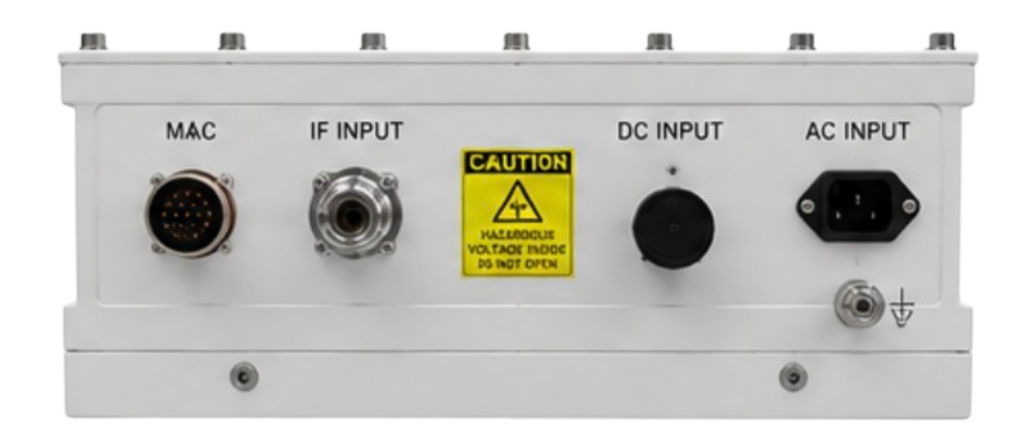
The AM-9338 operates from:
200–240 VAC
A 48 VDC operating option is also available.
Power consumption depends on the selected power rating:
| BUC Power | Maximum Power Consumption |
|---|---|
| 40W | 300W |
| 50W | 375W |
| 60W | 400W |
| 80W | 425W |
| 100W | 570W |
These values are maximum power-consumption figures specified in the manufacturer’s datasheet.
The optional 48 VDC configuration can be particularly useful for installations where DC power infrastructure is already available.
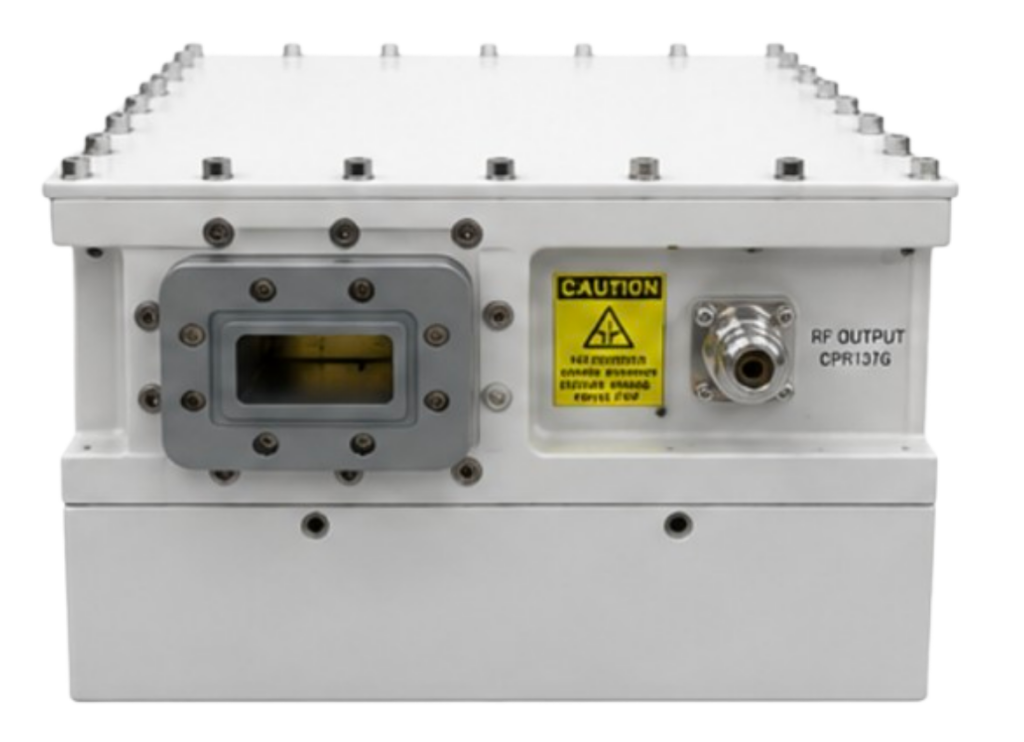
The AM-9338 provides dedicated interfaces for integration into a satellite transmit chain.
| Interface | Specification |
|---|---|
| IF Input | N-Type |
| RF Output | CPR 137G |
| Monitoring/Control | RS-232/485 |
| TCP/IP | Optional |
| FSK | Optional |
| Handheld Terminal | Optional RS-232 |
The datasheet notes that the N-Type IF input applies to the internal-reference model.
The CPR 137G RF output interface provides the high-power RF connection from the BUC toward the antenna/feed system.
Despite being a high-power outdoor BUC, the AM-9338 maintains a relatively compact physical package.
| Mechanical Parameter | Specification |
|---|---|
| Dimensions | 300 × 200 × 150 mm |
| Dimensions in inches | 11.8 × 7.9 × 5.9 in |
| Weight | 10 kg / 22 lb |
These dimensions and weight should be considered during antenna installation and mechanical integration, particularly when the BUC is mounted directly near the feed assembly.
The product’s external design, shown on page 1 of the datasheet, also clearly illustrates the integrated cooling-fan arrangement and outdoor enclosure.
The AM-9338 also incorporates an output sample port.
This can be useful during installation, commissioning, testing, and troubleshooting because it provides access to a sampled RF signal for measurement without requiring the primary RF output connection to be disrupted.
For professional VSAT engineers, this type of test access can simplify RF verification and maintenance procedures.

For mission-critical satellite networks, redundancy is often an important consideration.
The AM-9338 supports redundancy through an external redundancy controller, which the manufacturer specifies as required for redundancy operation.
This allows the BUC to be incorporated into systems designed with equipment redundancy, helping network architects develop higher-availability transmit chains.
For applications where satellite connectivity is operationally critical, redundancy can be considered alongside antenna, modem, power, and network redundancy.
The combination of high RF power, C-Band frequency coverage, outdoor protection, monitoring, and multiple power options makes the AM-9338 applicable to a range of satellite communication environments.
The AM-9338 can serve as the outdoor RF transmit component in professional VSAT systems where higher transmit power is required.
Teleport operators can use high-power BUC configurations as part of C-Band transmission infrastructure.
Organizations requiring dedicated satellite connectivity can use the BUC as part of their C-Band VSAT architecture.
The IP65 enclosure and -40°C to +55°C operating range make the platform relevant to outdoor and remote installations.
The high-power C-Band architecture can also be considered for satellite transmission systems where C-Band RF performance and power are required.
Actual suitability depends on the specific satellite link budget, frequency allocation, antenna/feed configuration, modem output, and regulatory requirements.
The AM-9338 Series offers several practical advantages for professional satellite networks:
Five power options from 40W to 100W allow system designers to match the BUC to their link requirements.
Standard C, Extended C, Full C, Ext-Palapa, and Insat configurations provide flexibility for different satellite frequency plans.
IP65 protection and an operating range of -40°C to +55°C support outdoor deployment.
RS-232/485, optional TCP/IP, FSK, and handheld control options make the BUC easier to manage.
The unit provides ±0.02 ppm internal frequency stability and defined phase-noise performance.
Field-removable fans simplify maintenance.
The standard 200–240 VAC configuration can be supplemented by an optional 48 VDC configuration.
The all-in-one design reduces the need for separate equipment in the outdoor transmit chain.
| Category | Specification |
|---|---|
| Product | Amplus AM-9338 Series C-Band BUC |
| Output Power Options | 40W / 50W / 60W / 80W / 100W |
| P-1dB Output | 46 / 47 / 48 / 49 / 50 dBm |
| Gain | 80 dB nominal |
| Gain Flatness | ±2 dB typical |
| Gain Stability | ±2 dB over temperature |
| Gain Control | 20 dB |
| Intermodulation | -25 dBc max |
| Spurious | -55 dBc max |
| Internal Frequency Stability | ±0.02 ppm |
| External Reference | 10 MHz |
| External Reference Level | -5 to +5 dBm |
| Input VSWR | 1.5:1 max |
| Output VSWR | 1.3:1 max |
| Phase Noise @ 100 Hz | -63 dBc/Hz max |
| Phase Noise @ 1 kHz | -73 dBc/Hz max |
| Phase Noise @ 10 kHz | -83 dBc/Hz max |
| Phase Noise @ 100 kHz | -93 dBc/Hz max |
| IF Input | N-Type |
| RF Output | CPR 137G |
| M&C | RS-232/485 |
| TCP/IP | Optional |
| FSK | Optional |
| Handheld Terminal | Optional |
| Input Voltage | 200–240 VAC |
| DC Option | 48 VDC |
| Power Consumption | 300–570W max, depending on model |
| Environmental Temperature | -40°C to +55°C |
| Humidity | 0–100% |
| Protection | IP65 |
| Dimensions | 300 × 200 × 150 mm |
| Weight | 10 kg / 22 lb |
| Redundancy | External redundancy controller required |
All technical values in this table are taken from the supplied Amplus AM-9338 Series C-Band BUC datasheet, Version 201809.

The most important point about the AM-9338 is that it is designed around the requirements of critical VSAT networks, rather than simply being a basic frequency converter.
Its high-power output options, C-Band frequency flexibility, stable reference architecture, environmental protection, monitoring and control functionality, and field-serviceable cooling make it a complete outdoor RF solution.
The availability of 40W through 100W configurations also means network designers can select an appropriate power class based on the actual link budget rather than over-specifying or under-specifying the BUC.
At the same time, the optional TCP/IP, FSK, handheld control, 48 VDC operation, and internal 10 MHz reference options provide additional flexibility for different network architectures.
If you are planning a new C-Band VSAT network, upgrading an existing satellite terminal, or looking for a high-power BUC for a professional satellite transmission system, the Amplus AM-9338 Series C-Band BUC is a strong option to consider.
VSATPlus offers the Amplus AM-9338 Series C-Band BUC in multiple power configurations, including 40W, 50W, 60W, 80W, and 100W.
You can contact VSATPlus for pricing, availability, configuration requirements, and ordering information.
When requesting a quotation, it is important to specify the required C-Band frequency configuration, output power, reference configuration, monitoring/control options, and power requirements so the appropriate AM-9338 configuration can be selected.
The Amplus AM-9338 Series C-Band BUC is a high-power outdoor BUC designed for demanding VSAT and satellite communication applications. With output-power options ranging from 40W to 100W, multiple C-Band frequency configurations, 80 dB nominal gain, ±0.02 ppm internal frequency stability, IP65 environmental protection, remote monitoring and control options, field-removable fans, and optional 48 VDC operation, the platform provides a comprehensive solution for professional satellite networks.
Its combination of RF performance, environmental resilience, maintenance features, and management capabilities makes it particularly relevant where reliable C-Band transmission is a priority.
Looking for the AM-9338 for your satellite network? Order the Amplus C-Band BUC from VSATPlus and contact our team for pricing, availability, and configuration support.