UAE: +971 6 55 222 55 | USA: +1 (833) VSAT 123

Staying connected is essential when you work, travel, or operate in locations where conventional mobile networks cannot be relied upon. Whether you are travelling through remote areas, working offshore, supporting field operations, or simply need a dependable communications solution beyond terrestrial cellular coverage, satellite connectivity provides an important alternative.
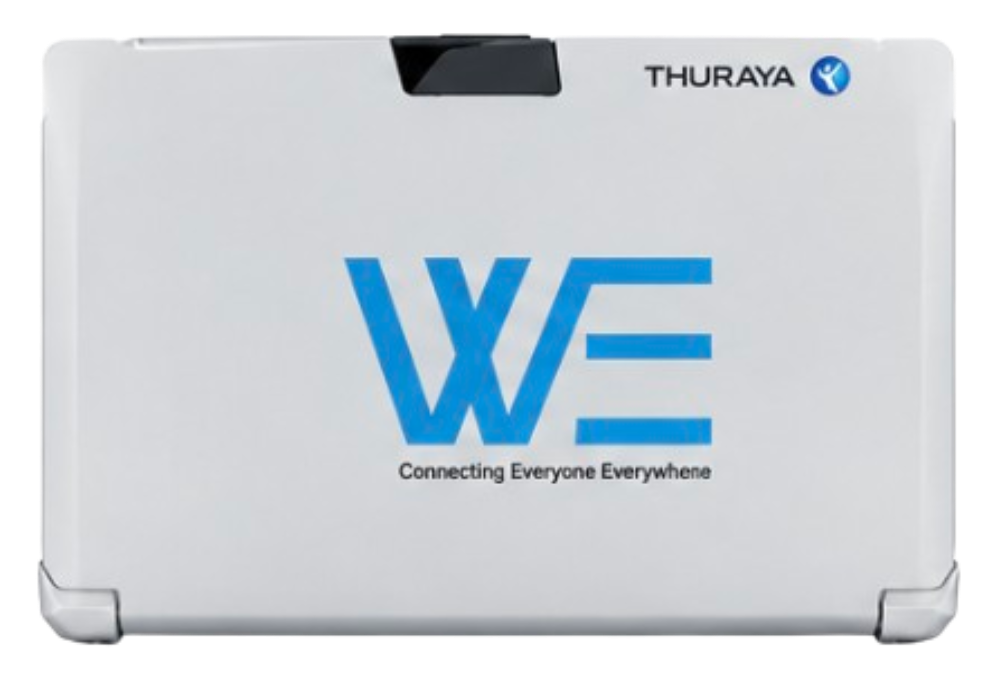
The Thuraya WE Satellite & LTE Hotspot is designed to bridge the gap between satellite and terrestrial cellular communications. Developed by Thuraya, it combines satellite connectivity and LTE/GSM connectivity in a single portable hotspot, allowing users to stay connected as they move between areas with and without conventional cellular coverage.
VSATplus offers the Thuraya WE for customers who need flexible satellite and cellular connectivity in a portable device. You can order the Thuraya WE from VSATplus along with the appropriate connectivity services and accessories for your requirements.
The Thuraya WE is a dual-mode Satellite & LTE hotspot. Its primary purpose is to provide internet connectivity through either a terrestrial cellular network or Thuraya's satellite network.
Instead of carrying separate equipment for satellite and cellular connectivity, users can employ the Thuraya WE as a single communications platform. The device can operate with a Thuraya SIM for satellite connectivity or a GSM SIM for cellular connectivity, depending on the configuration and available network coverage.
One of the central features of the product is its ability to switch between networks. Users can configure automatic network switching through the Thuraya WE mobile application or web interface, or manually select the desired network.
This makes the device particularly useful for people who regularly travel between areas with strong cellular coverage and remote locations where satellite communications are required.
The brochure describes Thuraya WE as the world's first dual-mode Satellite & LTE hotspot, designed to converge satellite and terrestrial communications in one device.
The biggest distinguishing feature of Thuraya WE is its dual connectivity capability.
When a suitable terrestrial GSM/LTE network is available, users can take advantage of cellular connectivity. When terrestrial coverage is unavailable, the device can switch to satellite connectivity, provided the user has appropriate satellite service and visibility to the Thuraya network.
This approach can significantly simplify communications for mobile and remote users.
For example, consider a field team travelling from a city into a remote area. During the first part of the journey, the team may have access to conventional LTE coverage. Once they move beyond cellular coverage, the Thuraya WE can be switched to satellite mode.
The device therefore acts as a communications bridge between terrestrial and satellite networks rather than requiring the user to carry two independent hotspot solutions.
Thuraya WE provides two methods for selecting the network.
The automatic network switching function can be configured through the web interface or smartphone application.
When enabled, the hotspot can automatically move from the default network to the alternative network when coverage is no longer available.
This can be particularly useful for users who travel frequently and do not want to repeatedly change network settings manually.
Users who want direct control can manually select the network through the Thuraya WE web interface or mobile application.
This gives operators flexibility over how the device uses satellite and terrestrial connectivity.
Another major benefit is that the Thuraya WE doesn't simply provide connectivity to one device.
It creates a Wi-Fi hotspot that can be shared with multiple compatible devices. According to the brochure, up to 10 smart devices can connect to the hotspot, with a Wi-Fi range of approximately 30 metres or more with clear line of sight.
This means a single Thuraya WE can provide connectivity for a small team rather than requiring individual satellite communication equipment for every user.
Laptops, smartphones, tablets and other compatible Wi-Fi devices can therefore share the connection.

Thuraya WE is not limited to internet data.
In satellite mode, the Thuraya WE application can transform a compatible smart device into a satellite phone. Users can access their existing phone contacts through the application and make satellite calls or send SMS messages.
This gives the device an additional communications function beyond Wi-Fi data connectivity.
For remote workers and travelling professionals, having access to voice and messaging can be important when data connectivity is not the only requirement.
Thuraya designed the WE interface to make the hotspot easier to configure and operate.
The device can be controlled through a web interface as well as a dedicated mobile application. The brochure states that the mobile application is compatible with iOS and Android systems.
Through the interface, users can perform several important functions, including:
This provides users with visibility into the device's operating condition and connectivity status.
Despite combining satellite and cellular functionality, Thuraya WE is designed as a portable communications device.
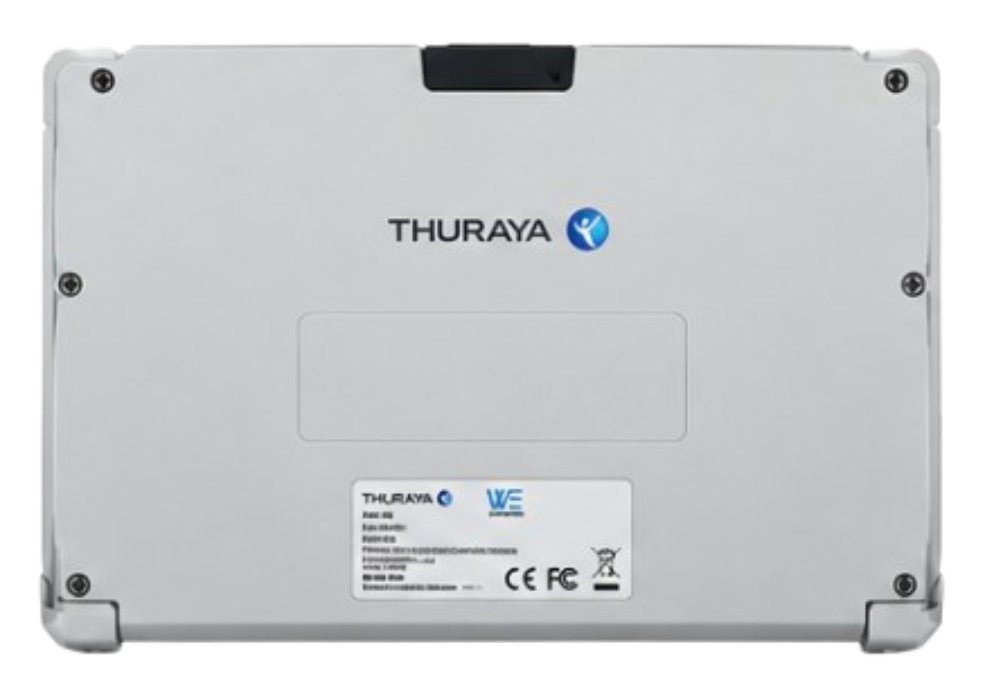
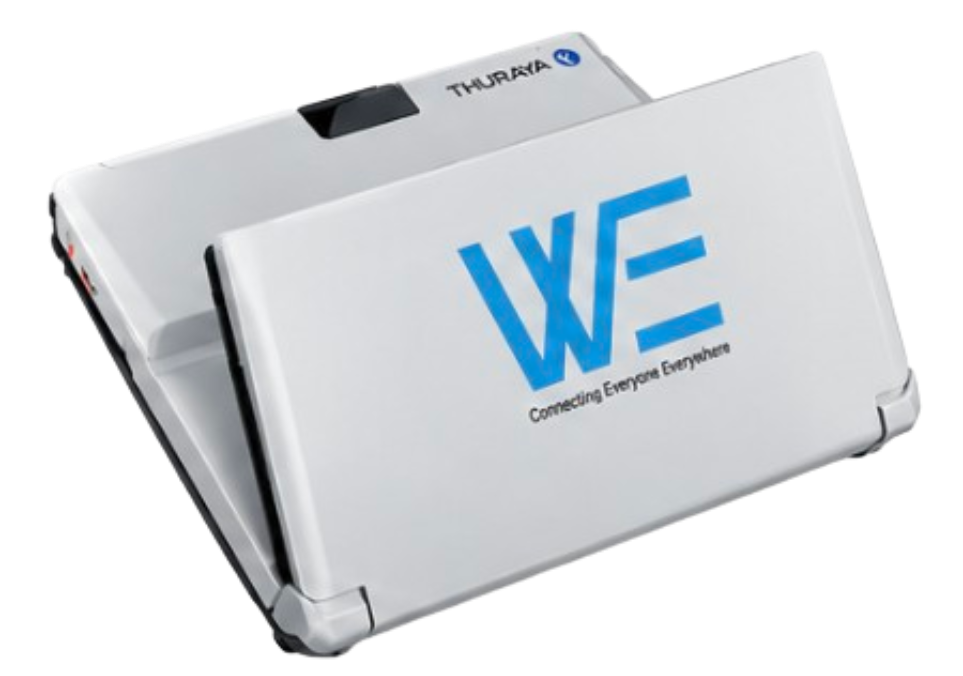
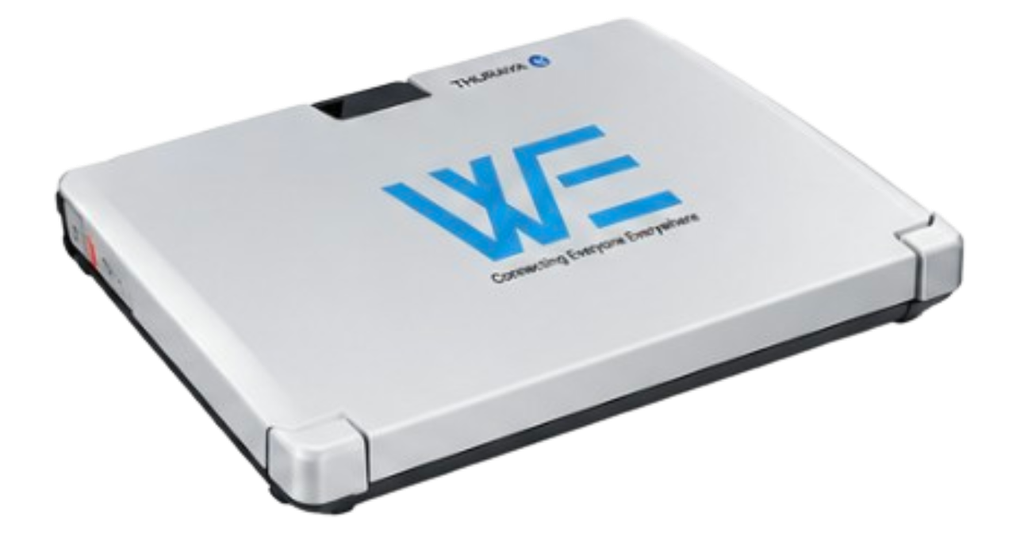
The brochure specifies a weight of 1.00 kg and dimensions of 230 mm × 197 mm × 24 mm.
Its relatively compact form makes it suitable for mobile operations where equipment needs to be transported between locations.
The device also carries an IP54 ingress protection rating, providing protection against dust and water spray from any direction. This is an important characteristic for users working in challenging environments.
Thuraya WE incorporates a rechargeable lithium-ion battery.
The manufacturer's stated battery runtimes vary according to the operating mode:
| Operating Mode | Stated Runtime |
|---|---|
| Cellular standby | Up to 20 hours |
| Cellular data | Up to 9 hours |
| Satellite standby | Up to 6 hours |
| Satellite voice | Up to 5 hours |
| Satellite data | Up to 3 hours |
Actual operating time can vary depending on factors such as network conditions, signal strength, usage pattern and device configuration.
The battery has a capacity of 7.4 V, 6 Ah, using a 2S2P configuration. The brochure specifies a minimum of 300 charge cycles at 75% depth of discharge (DoD).
The Thuraya WE combines satellite communications, cellular connectivity, Wi-Fi, routing functions and GNSS positioning.
| Specification | Thuraya WE |
|---|---|
| Satellite data | Up to 384 Kbps in standard mode |
| Satellite voice | Circuit-switched voice |
| Satellite SMS | Supported |
| Cellular | 3G / LTE |
| Wi-Fi | Supported |
| Wi-Fi clients | Up to 10 users |
| Wi-Fi range | 30+ metres with clear line of sight |
| Wi-Fi security | WPA2 Personal Authentication |
| GNSS | GPS, GLONASS, BeiDou |
| Satellite SIM | Mini SIM |
| Mobile applications | Android and iOS |
| API | Published API for third-party client application development |
These specifications make the Thuraya WE more than a simple satellite modem. It is a multi-function connectivity platform capable of supporting shared internet access, voice, SMS, positioning and network management.
For satellite communications, the Thuraya WE operates within the following frequency ranges:
| Satellite Parameter | Frequency |
|---|---|
| Transmit (Earth to Space) | 1626.5–1660.5 MHz |
| Receive (Space to Earth) | 1525–1559 MHz |
These are the satellite communication frequency ranges specified in the product brochure.
For terrestrial cellular connectivity, the brochure lists support for several frequency bands:
| Cellular Band | Frequency |
|---|---|
| Band 20 | 800 MHz |
| Band 5 | 850 MHz |
| Band 8 | 900 MHz |
| Band 3 | 1800 MHz |
| Band 1 | 2100 MHz |
| Band 7 | 2600 MHz |
The brochure also identifies 3G support for Band 5 (850 MHz) and Band 2 (1900 MHz).
Users should verify local network compatibility and service availability before purchasing or deploying the device for a particular cellular network.
Thuraya WE includes several router functions that allow users to manage network access.
The specified router features include:
These features can be useful when the hotspot is being integrated into a more structured network environment rather than being used simply as a personal Wi-Fi connection.
For professional deployments, network administrators can use these functions to control traffic, configure network access and manage connected devices.
The device supports three satellite positioning systems:
GNSS functionality can assist with positioning and location-related applications where supported by the device's software and configuration.
The Thuraya WE is designed to operate in demanding environmental conditions.
| Environmental Specification | Rating |
|---|---|
| Operating temperature | -20°C to +55°C |
| Transport temperature with battery | -20°C to +60°C |
| Storage temperature with battery | -20°C to +60°C |
| Battery charging temperature | 0°C to +45°C |
| Humidity | 5%–95% RH at 40°C |
| Ingress protection | IP54 |
| Weight | 1.00 kg |
| Dimensions | 230 × 197 × 24 mm |
The combination of IP54 protection and the stated temperature ranges makes the device suitable for a variety of field environments. Nevertheless, users should operate and store the equipment within the manufacturer's specified limits.
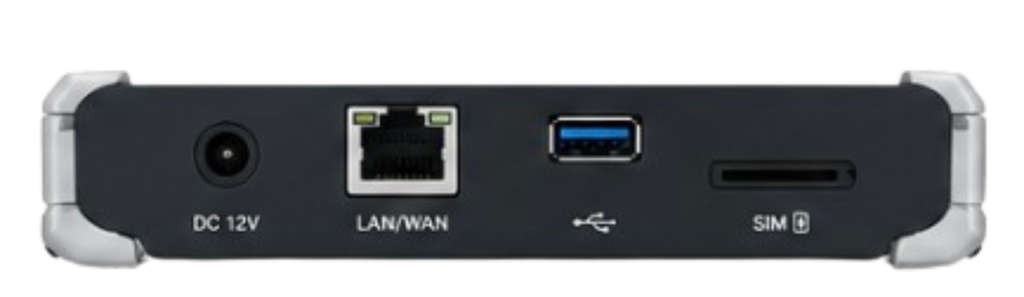
Thuraya WE uses a rechargeable lithium-ion battery and has a DC power input.
| Power Specification | Detail |
|---|---|
| Input voltage | 12 V DC |
| Maximum current | 3 A |
| Rated input | 12 V + 0.6 V |
| Battery | Rechargeable Lithium Ion |
| Battery capacity | 7.4 V, 6 Ah |
| Configuration | 2S2P |
| Minimum charge cycles | 300 at 75% DoD |
| DC connector | 2.5 mm ID / 5.5 mm OD jack |
| Polarity | Centre positive |
These specifications are particularly relevant for professional and mobile deployments where external power arrangements may need to be planned in advance.

Security is another important aspect of the device.
Thuraya WE supports WPA2 Personal Authentication for its Wi-Fi connection. It also incorporates several router-level security and network management functions, including firewall, MAC filtering, DMZ, NAT and port forwarding.
Together, these features provide users with control over how connected devices communicate through the hotspot.
The native client applications support both major mobile operating systems.
The brochure specifies:
| Platform | Minimum Version |
|---|---|
| Android | Android 4.2 / API 17 |
| iOS | iOS 9 |
The applications also include an integrated phonebook, allowing users to work with their contacts when using the device's satellite voice and SMS functionality.
The product also provides a published API for third-party client application development, offering an option for organizations that want to integrate the device with their own applications or workflows.
The dual-mode architecture makes Thuraya WE relevant to a wide range of users.
Professionals operating outside reliable terrestrial coverage can use satellite connectivity to maintain communications.
Survey teams, engineers, technicians and other field personnel can share one Wi-Fi connection across multiple devices.
For people travelling through areas where cellular coverage can disappear, satellite connectivity provides an alternative communications method where Thuraya coverage is available.
Organizations can use satellite connectivity as an additional communications option when terrestrial networks are unavailable or inaccessible.
The device can be relevant to certain offshore operations within the Thuraya service coverage area, subject to network availability, operating conditions and applicable service requirements.
Field production teams can benefit from a portable communications solution that can move between terrestrial and satellite coverage.
These examples describe potential applications; actual suitability depends on geographical coverage, service plans, network conditions and the user's specific operational requirements.
The product's main advantages come from combining multiple communications functions in one portable platform.
Dual connectivity: Users can access satellite and terrestrial cellular connectivity through one hotspot.
Network flexibility: Automatic and manual network selection provide control over how connectivity is managed.
Shared Wi-Fi: Up to 10 devices can connect to the hotspot.
Voice and SMS: Satellite mode supports voice calls and SMS through the Thuraya WE application.
Portable design: At approximately 1 kg, the unit is designed for mobile use.
Environmental protection: IP54 protection helps protect the device from dust and water spray.
GNSS support: GPS, GLONASS and BeiDou are supported.
Advanced networking: Firewall, MAC filtering, DMZ, NAT and port forwarding are included.
Mobile management: The device can be managed through Android and iOS applications as well as a web interface.
Satellite connectivity is not automatically available everywhere on Earth. Thuraya WE uses the Thuraya satellite network, and users should therefore verify that their intended operating area falls within the applicable satellite coverage.
The brochure describes Thuraya satellite connectivity across Europe, Africa, Asia and Australia and explains that the device can use a Thuraya SIM or a GSM SIM from Thuraya's data roaming partners in satellite mode.
Cellular operation depends on the availability of a compatible terrestrial network.
Therefore, before ordering for a specific project or location, customers should confirm the required coverage, SIM/service arrangement and network compatibility.
Traditional mobile hotspots depend entirely on terrestrial cellular networks. Once the user moves outside cellular coverage, the hotspot can no longer provide a cellular data connection.
Thuraya WE takes a different approach by incorporating satellite connectivity into the same platform.
This makes it particularly useful for users whose operating environment changes frequently. Instead of carrying separate cellular and satellite communication solutions, the user can employ one device capable of working across both connectivity types.
The result is a flexible communications platform designed around mobility and network availability.
If you are looking for a portable solution that combines satellite connectivity, LTE/GSM networking, Wi-Fi, voice, SMS and advanced routing functions, Thuraya WE is a versatile option to consider.
VSATplus has Thuraya WE available for customers looking for dual-mode satellite and cellular connectivity. You can order the product from VSATplus and discuss the appropriate connectivity/service requirements for your application.
Before placing an order, it is recommended to confirm your operating location, required satellite coverage, cellular compatibility, SIM/service requirements and expected data usage so that the configuration matches your specific needs.
The Thuraya WE Satellite & LTE Hotspot is designed for users who need connectivity that can move beyond the limits of conventional terrestrial networks. By combining satellite and LTE/GSM connectivity, the device provides a flexible way to maintain communications as users move between connected and remote areas.
Its feature set goes beyond basic internet access. With support for Wi-Fi for up to 10 users, satellite voice and SMS, automatic network switching, mobile applications, web management, GNSS, WPA2 security and advanced router functions, the Thuraya WE can serve as a compact communications hub for individual professionals and small teams.
Its portable 1 kg design, IP54 protection and rechargeable battery further support mobile and field-oriented applications.
For customers who require this type of dual-mode connectivity, VSATplus provides an option to order the Thuraya WE and obtain the connectivity solution required for their deployment. Whether the application involves remote work, field operations, travel, offshore activity, emergency communications or maintaining connectivity beyond cellular coverage, Thuraya WE brings satellite and terrestrial communications together in a single portable hotspot.