UAE: +971 6 55 222 55 | USA: +1 (833) VSAT 123

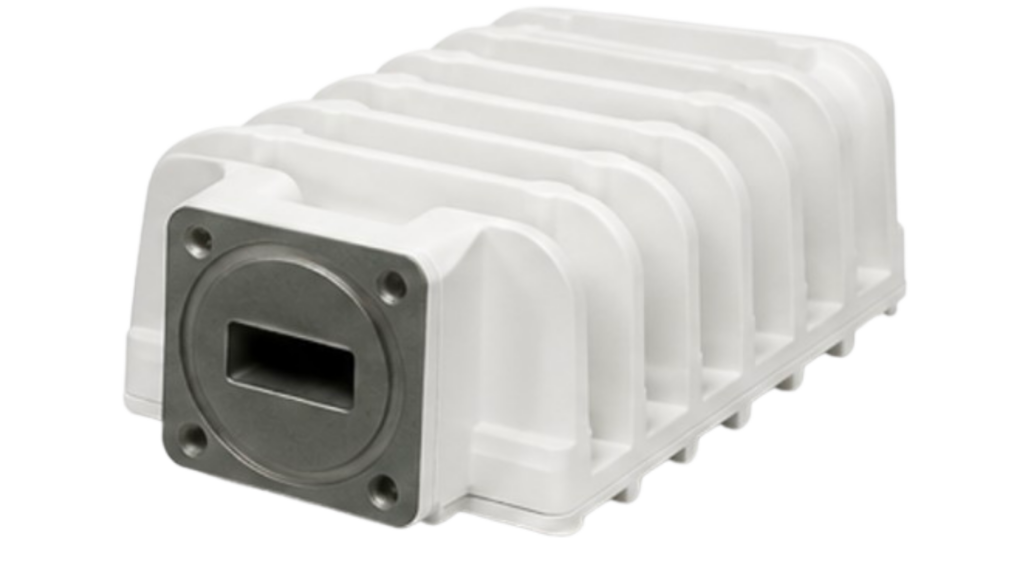
Reliable uplink performance is one of the most important requirements in any satellite communication system. At the RF front end, the Block Upconverter (BUC) plays a critical role by converting an intermediate-frequency (IF) signal into the appropriate Ku-band RF frequency and amplifying it to the required transmit power level.
The New Japan Radio (NJR) NJT8302 Series Universal/Standard Ku-band 3W BUC is designed as a compact, lightweight RF solution for Ku-band satellite communication systems. According to the manufacturer’s Rev.06 datasheet, the NJT8302 series provides 3W linear output power, supports both Universal Ku-band and Standard Ku-band configurations, offers a nominal 58 dB linear gain, and operates from a +12 to +30 V DC power supply.
For satellite communication integrators, network operators, broadcasters, and VSAT professionals looking for a small-form-factor Ku-band BUC, the NJT8302 combines RF performance, low power consumption, environmental protection, and flexible IF connector configurations in a remarkably compact package.
VSATPlus makes the New Japan Radio NJT8302 Series 3W Ku-band BUC available to customers looking for professional satellite communication RF equipment. Customers can contact VSATPlus for product availability, pricing, configuration requirements, and ordering.
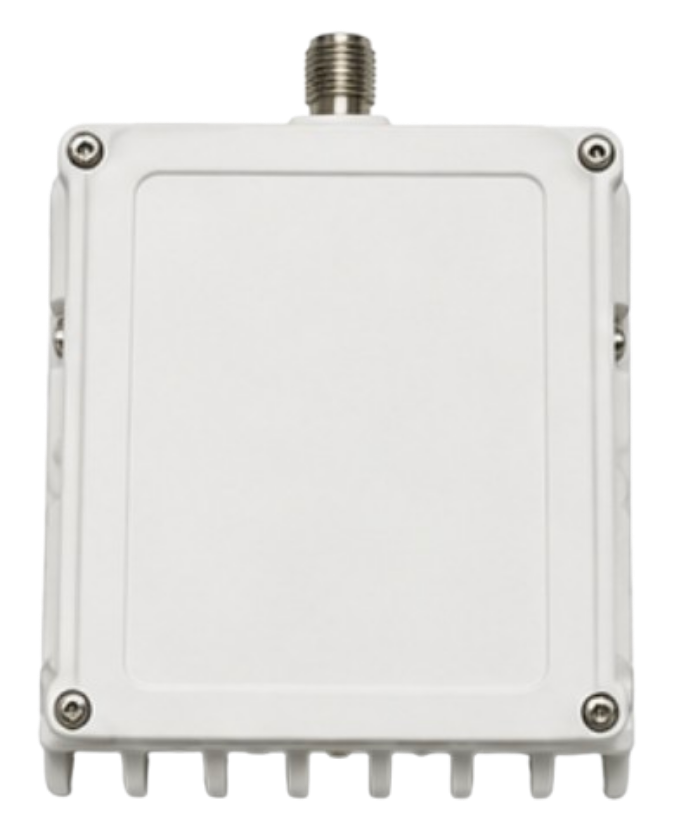
The NJT8302 is a 3W linear Ku-band Block Upconverter developed by New Japan Radio Co., Ltd. The unit converts an IF input signal into a Ku-band RF output while providing the amplification required for transmission through a satellite antenna system.
The product is offered in two principal RF configurations:
The Universal Ku-band models use a 12.80 GHz local oscillator, while the Standard Ku-band models use a 13.05 GHz local oscillator. The corresponding IF ranges are 950–1,700 MHz for the Universal Ku-band models and 950–1,450 MHz for the Standard Ku-band models.
The NJT8302 series is available with either an N-type female 50-ohm IF connector or an F-type female 75-ohm IF connector, allowing system designers to select the appropriate interface for their installation.
This flexibility makes the NJT8302 particularly practical when integrating the BUC into different satellite modem, feed, antenna, or IF distribution configurations.
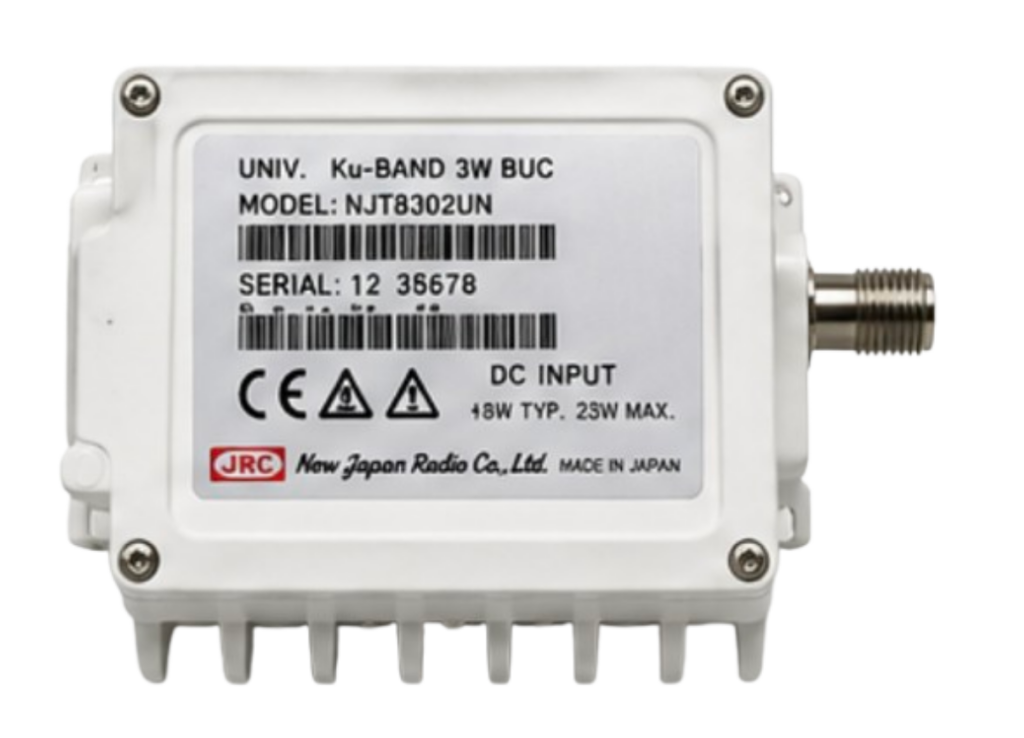
The NJT8302 is specified for a minimum output power of +34 dBm at P1dB, corresponding to approximately 3W of RF output power.
The manufacturer specifies this output level over the operating temperature range, which is an important characteristic for professional satellite communication equipment.
The unit also specifies an ACPR of -26 dBc minimum at Pout = +34 dBm.
For satellite communication systems, maintaining controlled RF output characteristics is important because excessive distortion or spectral regrowth can interfere with adjacent channels and reduce overall system efficiency.
One of the most useful characteristics of the NJT8302 family is the availability of both Universal and Standard Ku-band frequency configurations.
The Universal Ku-band configuration operates across:
13.75–14.5 GHz RF
with:
12.80 GHz Local Oscillator
and:
950–1,700 MHz IF
The Universal configuration is represented by:
The Standard Ku-band configuration operates across:
14.0–14.5 GHz RF
with:
13.05 GHz Local Oscillator
and:
950–1,450 MHz IF
The Standard configuration is represented by:
These configurations are summarized in the manufacturer’s line-up table on page 1 of the datasheet.
The following table consolidates the principal specifications provided in the NJT8302 Rev.06 datasheet.
| Parameter | NJT8302 Specification |
|---|---|
| Product Type | Universal/Standard Ku-band 3W BUC |
| RF Frequency – Universal | 13.75–14.5 GHz |
| RF Frequency – Standard | 14.0–14.5 GHz |
| Local Oscillator – Universal | 12.80 GHz |
| Local Oscillator – Standard | 13.05 GHz |
| IF Frequency – Universal | 950–1,700 MHz |
| IF Frequency – Standard | 950–1,450 MHz |
| Output Power @ P1dB | +34 dBm minimum |
| Linear Output | 3W |
| Linear Gain | 58 dB nominal / 51 dB minimum |
| ACPR | -26 dBc minimum @ +34 dBm |
| Output Interface | WR75 waveguide with groove |
| IF Connector Options | N-type female, 50 ohm / F-type female, 75 ohm |
| External Reference | 10 MHz sine-wave |
| External Reference Input Power | -5 to +5 dBm |
| Input VSWR | 2.0:1 maximum |
| Output VSWR | 2.0:1 maximum |
| Power Supply | +12 to +30 V DC |
| Typical Power Consumption | 18 W @ +34 dBm output |
| Maximum Power Consumption | 23 W @ +34 dBm |
| No-IF Power Consumption | 15 W maximum @ +25°C |
| Reference-Off Power | 2 W maximum |
| Operating Temperature | -40°C to +55°C |
| Storage Temperature | -40°C to +75°C |
| Humidity | 0–100% |
| Maximum Altitude | 15,000 ft / 4,572 m |
| Environmental Protection | IP67 |
| Dimensions | 91.55 × 68 × 42.5 mm |
| Weight | 350 g |
| LO Lock Indicator | Green |
| LO Unlocked / No Reference | Red |

The NJT8302 provides 58 dB nominal linear gain, with a minimum specified gain of 51 dB.
High gain is particularly useful because the BUC must take a relatively low-level IF signal from the modem or upstream equipment and amplify it sufficiently to produce the required RF transmit power.
The combination of high gain and 3W output capability allows the NJT8302 to be integrated into relatively compact RF architectures without requiring a large external amplification chain.
The gain specification is one of the important parameters system designers should consider when matching the BUC with the output level of a satellite modem or other IF source.
The NJT8302 supports an external 10 MHz sine-wave reference.
The specified reference input requirements are:
The external reference provides an important synchronization mechanism for applications where the BUC needs to operate from a system-level frequency reference.
The datasheet also specifies an automatic protection behavior: the HPA is shut off if the local oscillator becomes unlocked or if the required 10 MHz reference signal is unavailable. This is a useful protection feature for system reliability and RF operation.
The NJT8302’s local oscillator performance is also defined in the datasheet.
The specified LO phase noise is:
Low phase noise is important in satellite communication systems because unwanted oscillator noise can contribute to degradation of the transmitted signal and affect overall RF performance.
For systems operating in tightly controlled satellite channels, oscillator stability and phase-noise performance are therefore important selection criteria when comparing BUCs.
Although the NJT8302 is a transmit-side BUC, the manufacturer’s datasheet also specifies receive-band noise density.
For transmit frequencies of 13.75–14 GHz, the specified receive-band noise density is:
For transmit frequencies of 14–14.5 GHz, the specified receive-band noise density is:
These specifications are particularly relevant when the BUC is installed as part of an integrated satellite antenna/feed assembly where transmit and receive RF paths operate in close frequency proximity.
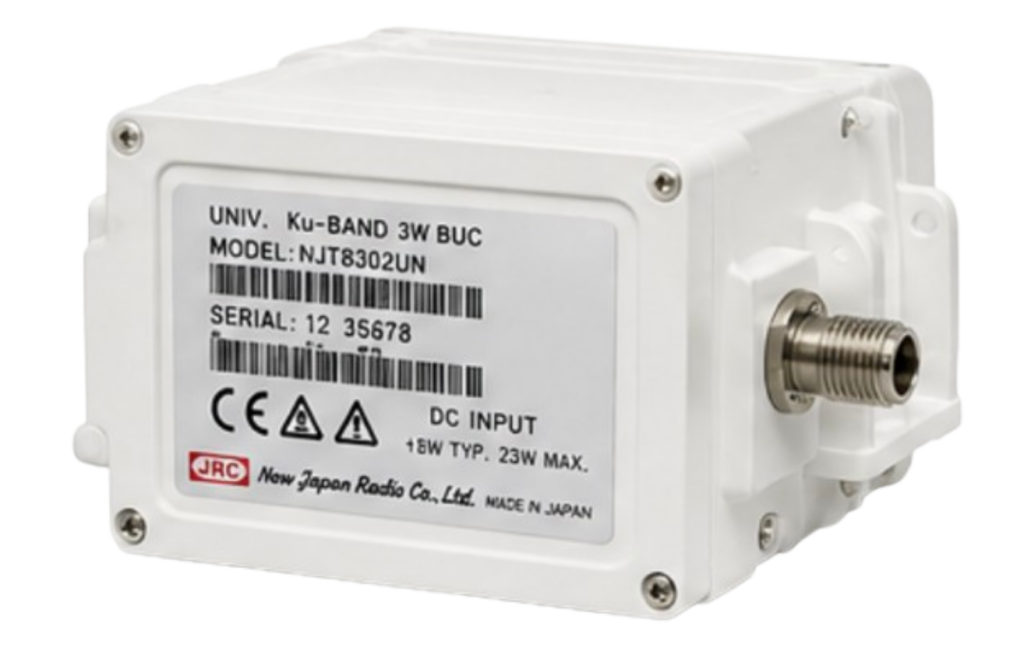
One of the strongest advantages of the NJT8302 is its physical size.
The housing dimensions are:
91.55 mm × 68 mm × 42.5 mm
or approximately:
3.60 × 2.68 × 1.67 inches
The specified weight is only:
350 g / 0.77 lb
This is exceptionally compact for a 3W Ku-band BUC.
The small footprint can be valuable for antenna installations where space and weight are limited. It can also simplify integration with compact outdoor units and antenna feed assemblies.
The outline drawings on pages 2 and 3 of the manufacturer’s datasheet provide detailed mechanical dimensions for both the N-type and F-type connector versions.
The NJT8302 is specified with an IP67 waterproof and dustproof rating.
This is particularly important because BUCs are commonly installed outdoors, close to satellite antenna feeds, where equipment can be exposed to environmental conditions.
The specified operating temperature range is:
-40°C to +55°C
while the storage temperature range extends to:
-40°C to +75°C.
The datasheet also specifies operation at altitudes up to:
15,000 feet / 4,572 meters
and humidity from:
0 to 100%.
These environmental specifications make the NJT8302 suitable for installations where compact RF hardware must operate outside controlled indoor environments.
Power efficiency is another significant advantage.
At +34 dBm output, the manufacturer specifies:
18 W typical power consumption
and:
23 W maximum
The unit requires a +12 to +30 V DC power supply.
When there is no IF input, maximum consumption is specified as 15 W at +25°C, while power consumption with the 10 MHz reference switched off and the unit muted can be as low as 2 W maximum.
For remote satellite terminals, portable systems, and installations where DC power availability is limited, these characteristics can simplify power-system design.
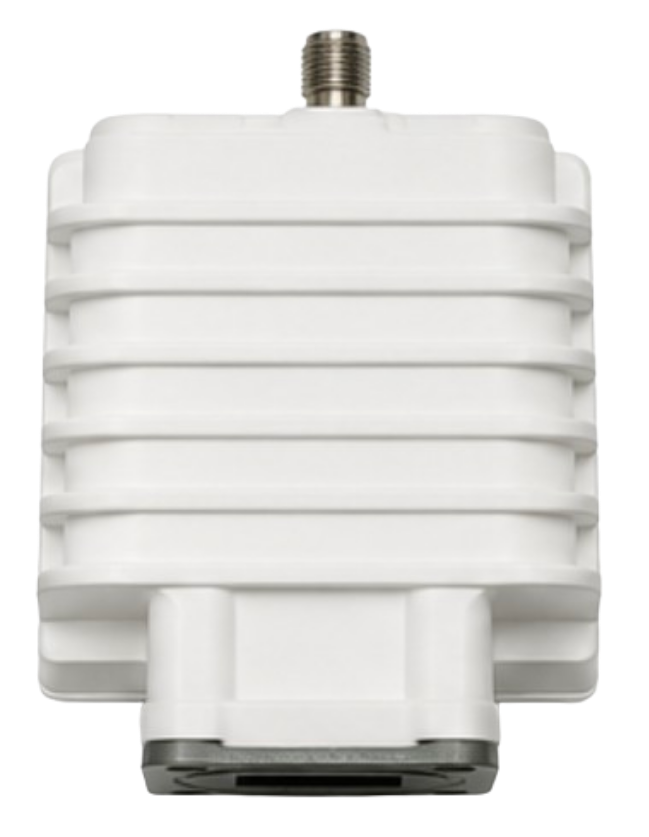
The NJT8302 series is offered with two different IF connector configurations.
The N-type models use a:
Female N-type, 50-ohm interface
These include:
The F-type models use a:
Female F-type, 75-ohm interface
These include:
The RF output uses a WR75 waveguide with groove.
This connector flexibility is useful when the BUC needs to be matched to different IF architectures.
The NJT8302 includes an LED status indicator for the local oscillator and reference condition.
According to the datasheet:
Green: L.O. locked
Red: L.O. unlocked or no 10 MHz reference signal
The BUC also incorporates a mute/protection function that shuts off the HPA if the LO becomes unlocked or the 10 MHz external reference is unavailable.
For field installations, this provides a straightforward visual indication of the unit’s operating state and can simplify troubleshooting.
The technical characteristics of the NJT8302 make it well suited for integration into professional Ku-band satellite communication equipment.
Potential applications include:
The 3W output power, compact design, DC operation, and Universal Ku-band support make the NJT8302 a practical candidate for compact VSAT terminal architectures.
The unit can be used as the RF amplification and frequency-conversion stage between an IF source and a Ku-band antenna/feed assembly.
Compact BUC architecture can be useful in satellite terminals where physical size, weight, and power consumption are important design considerations.
The Ku-band operating range and defined RF performance can support professional satellite transmission architectures where appropriate system configuration and link-budget requirements are met.
The IP67 environmental rating and wide operating temperature range make the unit particularly relevant for outdoor installations.
The exact suitability of the NJT8302 for a particular network should always be evaluated against the satellite operator’s frequency plan, modem output level, antenna size, link budget, regulatory requirements, and required EIRP.

The NJT8302 offers several practical advantages for satellite communication integrators.
Compact form factor: At only 350 g and approximately 92 × 68 × 43 mm, the BUC is easy to integrate into space-constrained systems.
3W linear output: +34 dBm minimum P1dB output provides a useful RF power level for compact Ku-band systems.
Universal Ku-band capability: The 13.75–14.5 GHz configuration covers a broad Ku-band transmit range.
Flexible IF interfaces: N-type 50-ohm and F-type 75-ohm versions provide integration flexibility.
Low power consumption: Typical consumption is only 18 W at rated output.
Outdoor-ready construction: IP67 protection supports demanding environmental installations.
Wide temperature range: Operation from -40°C to +55°C provides substantial environmental tolerance.
External reference support: A 10 MHz reference input enables system-level frequency synchronization.
LO protection: The HPA is shut down when the LO is unlocked or the external reference is unavailable.
| Model | RF Band | LO | IF Range | IF Connector | Power |
|---|---|---|---|---|---|
| NJT8302UN | Universal Ku 13.75–14.5 GHz | 12.80 GHz | 950–1,700 MHz | N-type | +12 to +30 V DC |
| NJT8302UF | Universal Ku 13.75–14.5 GHz | 12.80 GHz | 950–1,700 MHz | F-type | +12 to +30 V DC |
| NJT8302N | Standard Ku 14.0–14.5 GHz | 13.05 GHz | 950–1,450 MHz | N-type | +12 to +30 V DC |
| NJT8302F | Standard Ku 14.0–14.5 GHz | 13.05 GHz | 950–1,450 MHz | F-type | +12 to +30 V DC |
All four models provide the specified 3W linear output / +34 dBm minimum at P1dB.
The mechanical drawings included in the supplied datasheet provide detailed dimensional information for both connector configurations.
The main housing is approximately 91.55 mm long and 68 mm wide, with a height of 42.5 mm excluding the interface connectors.
The N-type and F-type versions have slightly different overall dimensions because of their respective connector arrangements. The drawings on pages 2 and 3 identify mounting dimensions, connector positions, sealing features, grounding points, and other mechanical details required for integration.
For installation, system designers should use the manufacturer’s mechanical drawings rather than relying only on the headline housing dimensions.
A BUC should not be selected purely based on output power. The more important question is whether its RF characteristics, frequency range, interfaces, power requirements, environmental performance, and physical dimensions match the complete satellite system.
The NJT8302 has a particularly balanced specification for compact Ku-band systems.
It combines:
This combination makes it a strong option when the objective is to achieve professional Ku-band RF performance without adding unnecessary size, weight, or power requirements.
If you are looking for a compact 3W Ku-band BUC for a professional satellite communication application, the New Japan Radio NJT8302 Series offers a technically strong solution.
VSATPlus has the NJT8302 available for customers who require professional satellite communication equipment.
Whether you need the Universal Ku-band version or the Standard Ku-band version, or whether your system requires an N-type 50-ohm or F-type 75-ohm IF interface, the NJT8302 family provides multiple configuration options.
Before ordering, customers should confirm the required:
Contact VSATPlus for pricing, availability, configuration assistance, and ordering information.

The New Japan Radio NJT8302 Series Universal/Standard Ku-band 3W BUC is a compact RF solution designed for Ku-band satellite communication systems. With +34 dBm minimum P1dB output, 58 dB nominal gain, Universal Ku-band coverage from 13.75 to 14.5 GHz, Standard Ku-band coverage from 14.0 to 14.5 GHz, and support for an external 10 MHz reference, it provides the core RF characteristics required by many professional satellite uplink architectures.
Its compact 91.55 × 68 × 42.5 mm housing and 350 g weight make it particularly attractive where installation space and equipment weight matter. At the same time, its IP67 protection, -40°C to +55°C operating temperature range, and support for operation at altitudes up to 15,000 feet provide the environmental characteristics needed for demanding installations.
The availability of both N-type 50-ohm and F-type 75-ohm IF connector configurations further expands integration flexibility.
For satellite communication professionals who need a small, efficient, environmentally protected Ku-band BUC, the NJT8302 is a compelling option.
The New Japan Radio NJT8302 Series is available through VSATPlus. Contact VSATPlus today for pricing, availability, and ordering information.